What Should You Consider When Deciding Between Roof Repair and Replacement?
When you notice missing shingles after a severe windstorm or spot a damp stain spreading across your hallway ceiling, your initial reaction might be to assume the entire roof is failing. However, jumping straight to a full replacement is not always necessary. Data across thousands of residential roof inspections indicates that roughly 70% of evaluated roofs can be successfully repaired rather than replaced. In many cases, a targeted fix can restore watertight integrity and buy an additional 8 to 12 years of reliable protection, though repair can cost thousands of dollars, and severe cases can cost much more.
To determine whether your home requires a spot repair or a complete tear-off, you must evaluate several structural and financial variables:
- Roof Age vs. Rated Lifespan: Is your roof nearing or past 80% of its expected service life?
- Damage Scope: Is the physical damage isolated to a single small area or widespread across multiple roof slopes?
- Decking and Underlayment Condition: Is the wood sheathing beneath the shingles firm and dry, or is it soft, rotted, and compromised by moisture?
- Leak Frequency: Are you dealing with a single isolated leak near a chimney, or are active leaks popping up in multiple unrelated spots?
- The Cost Math: Does the repair estimate exceed 30% to 50% of the cost of a brand-new roof?
- Local Climate Stressors: How severely have Central Wisconsin freeze-thaw cycles, heavy snow loads, and ice dams impacted the roof system?
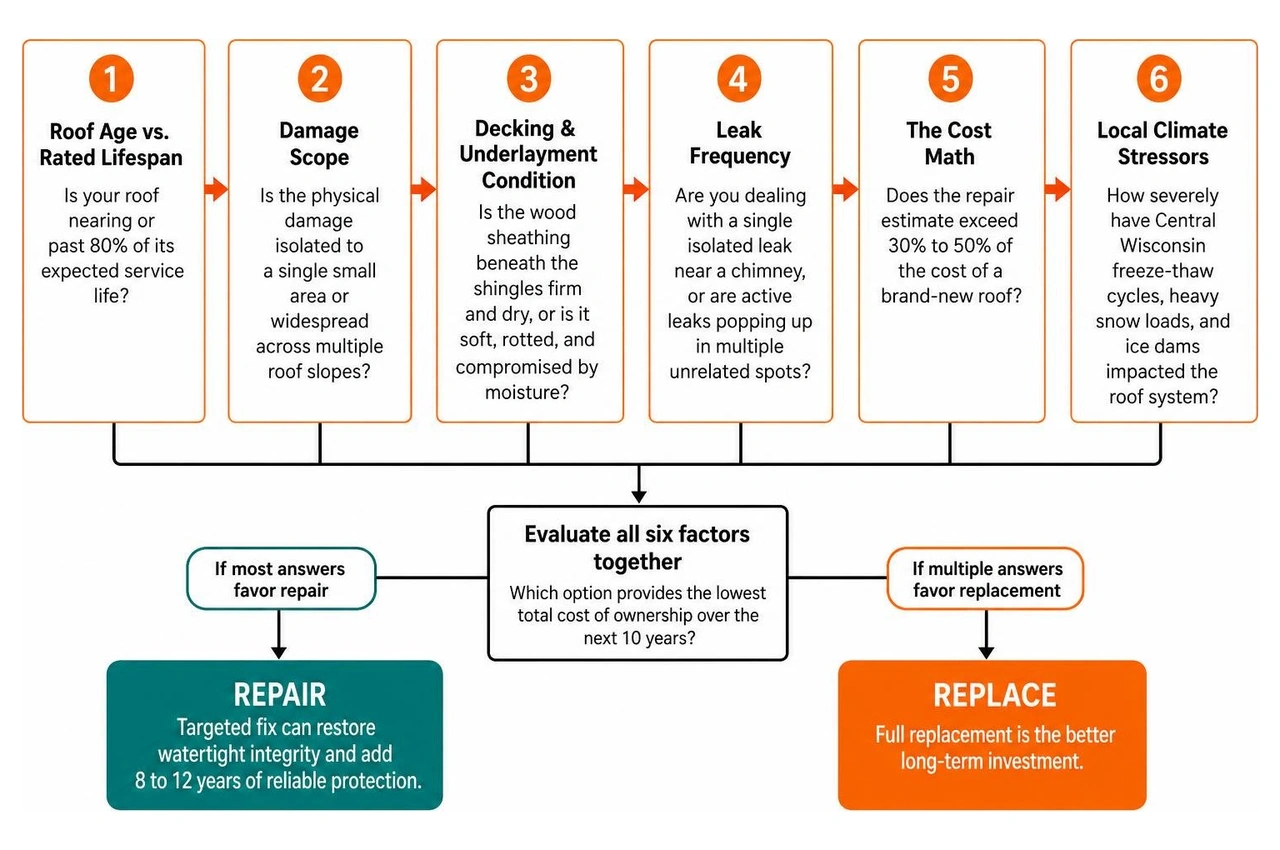
By systematically evaluating these core factors, you can move away from guesswork and choose the option that offers the lowest total cost of ownership over the next 10 years.
How Do Age and Roofing Material Determine If You Need a Replacement?
Every roofing material comes with an engineered design life. While high-grade materials can last for generations, standard residential shingles slowly break down over time due to solar ultraviolet (UV) radiation, severe wind exposure, and thermal expansion and contraction.
Here is how typical lifespans break down across primary residential roofing materials (though actual service life commonly varies by product, installation, ventilation, maintenance, and weather exposure):
- 3-Tab Asphalt Shingles: Typically last 15 to 20 years under normal conditions.
- Architectural (Laminated) Asphalt Shingles: Commonly last 25 to 30 years due to dual-layer construction.
- Metal Roofing (Standing Seam or Corrugated): Typically lasts 40 to 70 years.
- Clay and Concrete Tile: Often lasts 50 to 100 years (though underlayment beneath tiles usually requires replacement after 25 to 35 years).
- Slate: Commonly lasts 100+ years.
In Central Wisconsin, winter weather places unique stress on these materials. Repeated freeze-thaw cycles force water into micro-cracks in aging shingles, expanding as it freezes and accelerating wear. To better understand how these wear patterns develop, you can read more in this guide to Understanding Residential Roof Repairs.
How does a roof's age impact its repair viability?
Roof age sets the practical ceiling for repair viability. Once an asphalt shingle roof reaches 80% of its expected lifespan (roughly 12 to 15 years for 3-tab shingles or 20 to 22 years for architectural shingles), paying for localized spot repairs yields diminishing financial returns.
As asphalt shingles age, they lose their volatile oils, becoming stiff and brittle. When a contractor attempts to perform a spot repair on an old roof by lifting surrounding shingles to insert new ones, neighboring shingles often snap or tear. Furthermore, new shingles rarely seal properly to old, weathered asphalt.
A practical metric to evaluate age is the annual cost per remaining year of service:
$$\text{Annual Cost} = \frac{\text{Repair Estimate}}{\text{Expected Years the Repair Will Buy}}$$
If you pay for a substantial patch on a 22-year-old asphalt roof that only lasts another 18 months before the next section fails, your annualized cost can become difficult to justify. Investing that money toward a complete replacement with a fresh warranty is often the more economical financial choice.
What Physical Warning Signs Indicate You Need a New Roof vs. a Simple Repair?
Diagnosing your roof begins with a careful ground-level visual check around your perimeter and an inspection inside your attic space. You do not need to walk on a steep roof to identify early warning signs of system failure.
Which symptoms point to minor, localized roof repairs?
When damage is limited to a specific area and the rest of the roof field remains healthy, targeted Roof Repairs are the ideal choice. Minor, repairable issues include:
- Isolated Missing or Damaged Shingles: A few shingles torn off a single slope during a severe windstorm, provided the surrounding shingles are pliable and underlayment is intact (typically covering less than 10% to 15% of the total roof area).
- Damaged Pipe Boots or Vent Flashing: Cracked neoprene rubber boots around plumbing vent stacks or rusted vent flashing causing a leak directly beneath the penetration.
- Localized Chimney Flashing Leaks: Failed caulking, loose step flashing, or damaged counter-flashing around a chimney stack while surrounding shingles remain sound.
- Minor Lifted Shingle Tabs: Shingles lifted by moderate wind that can be re-sealed with professional-grade roofing cement before water penetrates underneath.
When caught early, addressing these minor issues prevents water from reaching structural framing, extending your roof's useful life by several years.
Which warning signs demand a complete roof replacement?
Conversely, physical signs that indicate systemic material failure across the roof field demand a complete replacement:
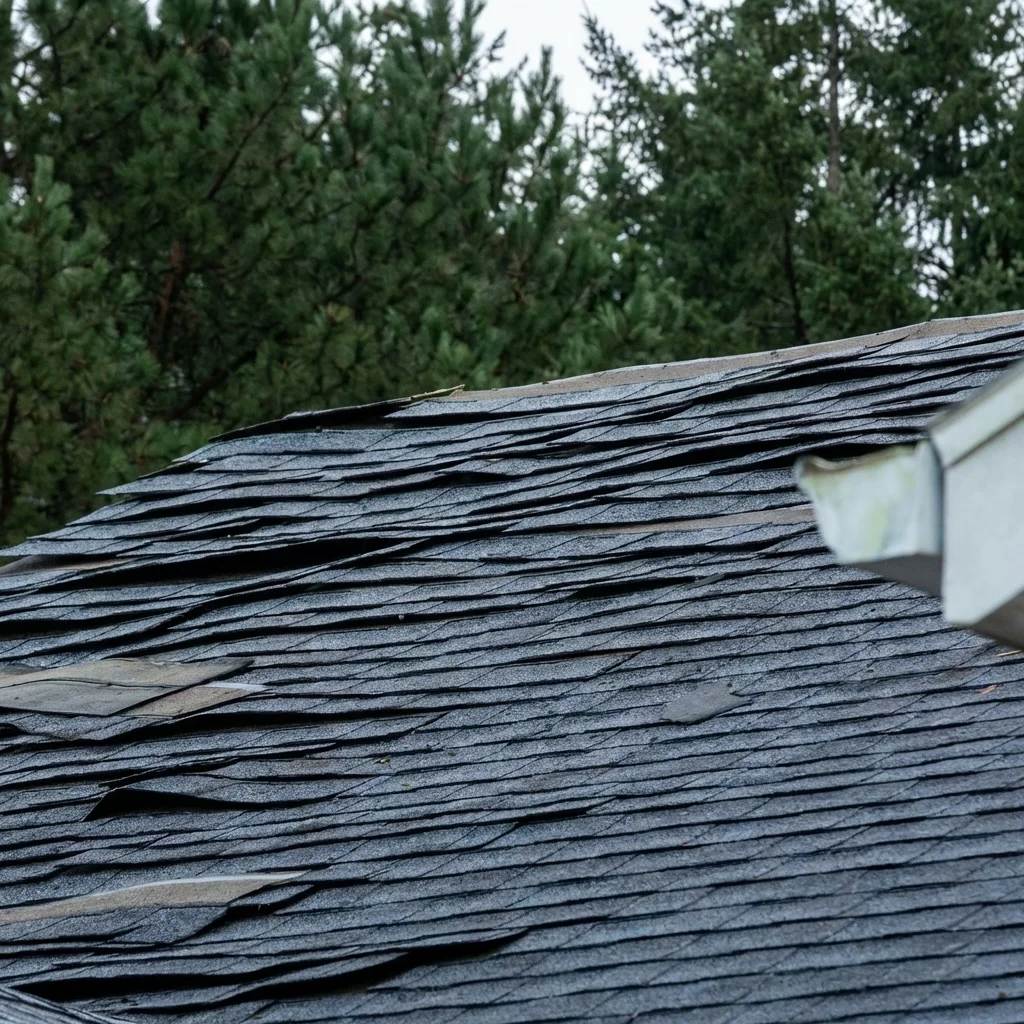
- Heavy Granule Loss ("Roof Sand") in Gutters: Granules protect the underlying asphalt from UV degradation. Finding thick piles of granules sloughing off into downspouts signals that shingles have reached the end of their functional life.
- Curling, Cupping, or Clawing Shingles: When shingle edges curl upward (cupping) or center sections bubble (clawing), the asphalt backing has dried out and lost structural integrity.
- Widespread Shingle Loss or Cracking: Shingles missing across multiple slopes or severe hairline cracking running through shingle fields.
- Daylight Visible Through Attic Sheathing: Stepping into a dark attic on a bright day and seeing pinpricks of sunlight coming through roof boards (excluding functional soffit or ridge vents).
- Sagging or Wavy Rooflines: A roofline that dips or sags indicates structural plywood sheathing or rafter decay beneath the shingles. You can review detailed diagnostic steps in our guide on Signs of Hidden Roof Damage.
How Do Damage Scope, Decking Condition, and Recurring Leaks Affect the Decision?
The condition of the structural roof decking (plywood or oriented strand board sheathing) beneath your shingles is often the ultimate deciding factor between repair and replacement.
If a leak goes unnoticed, moisture penetrates the synthetic underlayment and saturates the wood deck. Over time, moisture causes plywood to delaminate, swell, and rot. Walking on rotted decking feels soft or spongy underfoot. If structural decking rot covers more than 20% to 30% of the roof deck, spot repairs are no longer feasible because new shingles cannot be securely nailed into rotted, decayed wood.
In these situations, a complete tear-off is mandatory. This structural reality reinforces Why You Should Not Roof Over Existing Shingles. Installing a second layer of shingles over damaged decking hides active wood decay, adds weight, reduces wind resistance, and voids manufacturer warranties.
What do recurring leaks in multiple locations signal about your roof system?
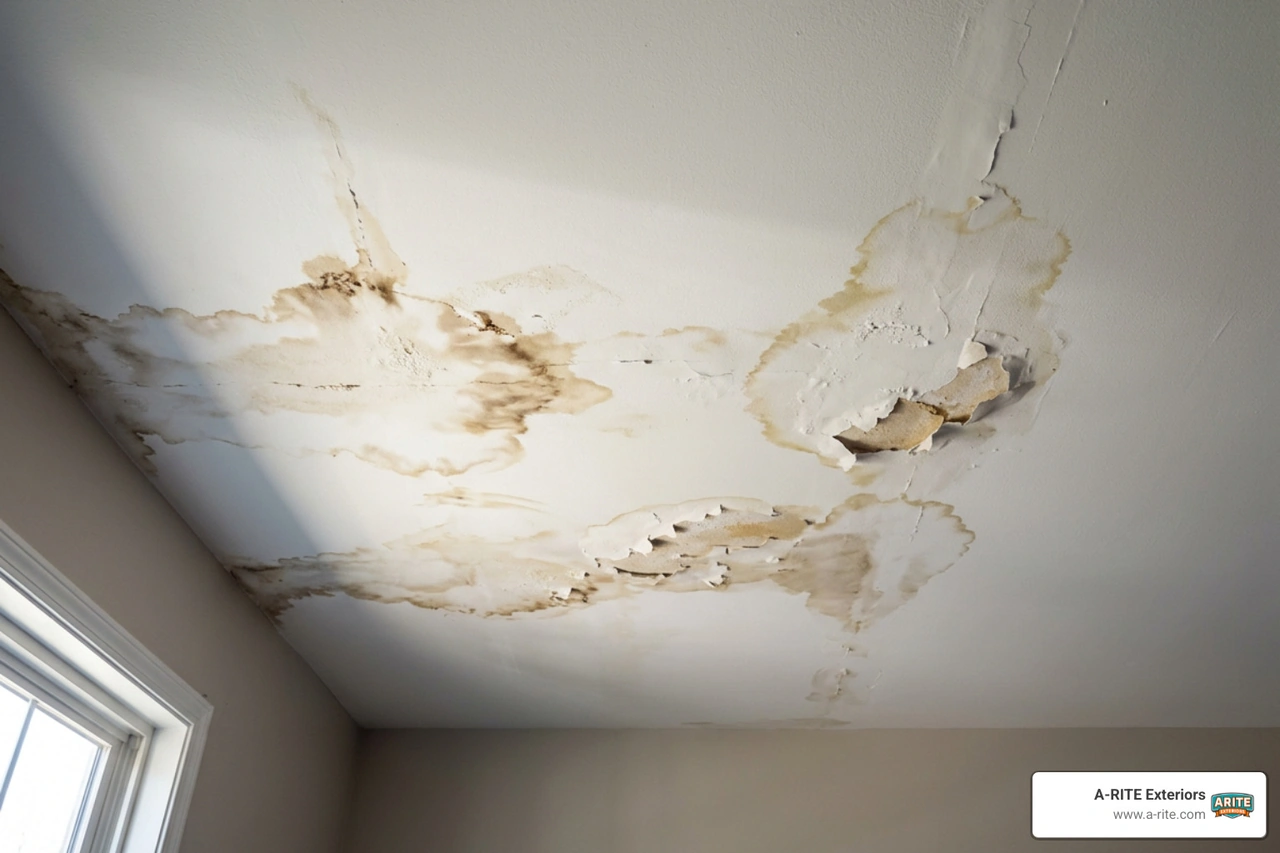
A single active leak near a pipe boot or chimney indicates a localized flashing failure. However, when water stains appear on ceiling drywalls in multiple separate rooms after heavy rains, the issue is systemic.
Recurring, multi-point leaks indicate that the underlying water-resistive barrier (underlayment) and primary shingle layer have degraded across the board. In cold climates like Central Wisconsin, this degradation is accelerated by ice dams.
When meltwater from warm attics runs down to cold eave overhangs, it freezes, creating ice dams that trap backed-up water under shingles. Water driven under aging shingles saturates decking along the eaves and creates multiple interior leak pathways.
To break this cycle, a full replacement must address both the exterior roof membrane and interior thermal performance:
- Water-Resistive Barrier: Installing ice and water shield membrane along eaves, valleys, and penetrations during replacement.
- Proper Attic Ventilation: Ensuring balanced intake soffit vents and exhaust ridge vents maintain cool attic temperatures.
- Dedicated Attic Insulation: Upgrading attic insulation helps reduce warm interior air from escaping into the attic space, managing thermal triggers associated with ice dams. (Note: A-RITE Exteriors exclusively provides attic insulation to manage thermal performance and protect roof assemblies).
How Do the 30% and 50% Cost Rules Help Calculate Repair vs. Replacement Value?
When evaluating contractor estimates, applying clear mathematical thresholds removes emotional guesswork from the decision.
| Decision Criteria | Targeted Minor Repair | Major Structural Repair | Full Roof Replacement |
|---|---|---|---|
| Typical Cost Scope | Lower-tier spot fix | Mid-tier extensive patch | Complete system investment |
| Surface Area Affected | Under 10% to 15% | 15% to 30% | Greater than 30% |
| Expected Lifespan Extension | 3 to 8 years | 5 to 10 years | 25 to 50+ years |
| Decking / Structural Coverage | Assumes sound decking | Spot decking replacement | Complete deck restoration |
| Resale Return on Investment | Low direct resale impact | Preserves home equity | Recoups 60% to 70% at resale |
How do the 30% area rule and 50% cost rule work in practice?
Professional roofing contractors use two primary mathematical rules of thumb:
- The 30% Area Damage Rule: If physical damage, missing shingles, or rotted sheathing affects 30% or more of the total roof surface area, replacement is almost always the superior choice. Attempting to repair more than 30% creates mismatched shingle fields and leaves aging underlayment beneath the remaining 70%.
- The 50% Cost Ratio Rule: If a single repair quote exceeds 50% of the cost of a full replacement, full replacement is the smarter financial decision. Furthermore, if cumulative repair quotes over a 3- to 5-year period exceed 30% of replacement cost on an aging roof, patching becomes a temporary drain on home equity.
For example, if a major repair quote comes in at roughly 45% of the cost of replacing the roof entirely, spending that much to maintain aging shingles is often financially inefficient. Replacing the roof provides a fresh 20- to 50-year warranty, improved energy performance, and complete structural peace of mind.
What are the typical costs and resale value impacts of a new roof?
Nationally, residential roof replacements often range from upper four figures to mid five figures, depending on factors like roof size, pitch, layers, decking condition, materials, and labor requirements. Complex complete tear-offs featuring high-grade architectural shingle systems in regional North Central climates commonly trend higher within that broad range based on structural requirements.
Despite the initial investment, a new roof is one of the highest-returning home improvement projects. According to Remodeling Magazine's Cost vs. Value Report, a new asphalt shingle roof typically recoups 60% to 70% of its initial cost in added home resale value. Buyers recognize the value of a warrantied, leak-free roof, which eliminates major inspection negotiation hurdles during sale.
To establish a clear budget for your property, you can generate an estimated price range through our Instant Roof Quote tool.
How Do Insurance Claims and Future Homeowner Plans Change Your Strategy?
Financial calculations shift significantly when storm damage or long-term occupancy plans enter the equation.
How does home insurance cover storm damage versus normal wear and tear?
Homeowners insurance policies are designed to cover sudden, accidental damage from covered perils, such as severe windstorms, hail events, or fallen tree branches. They specifically exclude gradual deterioration, normal age-related wear, and neglected maintenance.
According to insurance industry data, approximately 1 in 36 insured homes files a wind- or hail-related property claim each year, with an average claim payout of $14,747.
When severe weather hits, insurance carriers evaluate whether to cover localized repairs or full replacement based on scope and material availability:
- Partial Repair Coverage: If hail or wind damage is confined to a single slope, insurance may only cover repairs for that specific elevation.
- Full Replacement Coverage: If storm damage covers multiple slopes, or if your existing shingle line is discontinued (making a direct visual and functional match impossible), insurance policies often cover a full roof replacement (minus your deductible).
If you suspect recent weather damage, schedule a professional Storm Damage Roof Assessment Mosinee to document physical impacts, evaluate Roof Damage From High Winds, or confirm hail strikes via a dedicated Hail Damage Wausau inspection before filing a claim.
How does your timeline in the home affect your repair vs. replace strategy?
Your long-term housing plans should heavily influence whether you patch or replace:
- Short-Term Horizon (Selling in 1 to 3 Years): If your roof is structurally sound with no active leaks, performing targeted repairs is usually the best way to maximize return on investment (ROI). However, if the roof is past 20 years old or shows obvious visible wear, home inspectors will flag it, often requiring a seller concession or full replacement before closing.
- Long-Term Horizon (Staying 5+ Years): If you plan to remain in your home for five years or more, full replacement is the clear winner. You benefit directly from helping lower your heating bills, total protection against severe winter weather, and avoiding ongoing repair costs over time.
How Can You Choose the Right Strategy with Professional Help in Wisconsin?
Making the right decision requires an accurate, unbiased evaluation of both your exterior shingles and interior attic structure. Avoid contractors who give quick phone estimates without climbing into the attic space to inspect decking, insulation levels, and ventilation pathways.
When evaluating local contractors, use a structured Roofing Contractor Selection Guide to verify licensing, general liability insurance, worker's compensation, and manufacturer certifications. Understanding How Often Should Roofs Be Inspected, ideally twice a year and after major weather events, ensures small issues are identified before structural rot takes hold.
How does A-RITE Exteriors deliver weather-resistant roofing and attic insulation solutions?
At A-RITE Exteriors, we take a roof-first approach engineered specifically for Central Wisconsin's severe winter storms, freeze-thaw cycles, and summer wind events. Serving communities across Wausau, Mosinee, Stevens Point, Merrill, Green Bay, and surrounding areas, our team delivers comprehensive exterior solutions built to last.
When a full replacement is required, we install high-performance architectural Roofing systems designed for maximum durability, where some architectural shingles are rated up to 110 to 130 mph when installed as part of the required system.
To protect that investment, we integrate specialized attic insulation. (A-RITE Exteriors exclusively provides attic insulation services to preserve roof assemblies and stop thermal loss). Proper attic insulation seals building envelopes, regulates attic temperatures, and helps minimize ice dam formation.
Pricing, Financing, Rebates, and Tax Credit Guidelines
When evaluating contractor quotes, keep in mind that a lower price may reflect differences in materials, scope, cleanup, warranty coverage, or installation details. To help homeowners manage project investments, financing options are available for qualifying homeowners. Loan amounts up to $100,000 unsecured may be available, with final approval, rates, and terms based on lender review and credit qualification.
Additionally, homeowners may qualify for Focus on Energy rebates. It is important to note that Focus on Energy rebates apply to qualifying insulation and air-sealing work (such as attic insulation, air sealing, wall insulation, foundation insulation, duct sealing, and qualifying DIY attic insulation and air sealing), not for roof replacement itself. Rebate amounts and eligibility rules change over time, so homeowners should confirm current program guidelines directly with Focus on Energy prior to starting work.
Regarding federal tax credits, IRS guidance showed that Section 25C (Energy Efficient Home Improvement Credit) was available through December 31, 2025. Homeowners should consult a qualified tax professional to verify active tax credit qualifications for current tax years. Verified neutral sources for pricing, financing, rebates, and energy guidance include the IRS, ENERGY STAR, EPA, Focus on Energy, USDA, Wisconsin DSPS, GAF, Owens Corning, and the BBB.
What Are the Most Frequently Asked Questions About Roof Repair vs. Replacement?
Is it worth repairing a 20-year-old asphalt shingle roof?
In most cases, spending significant money to repair a 20-year-old asphalt shingle roof yields diminishing financial returns. Key considerations include:
- 3-Tab Shingles: At 20 years, 3-tab shingles are typically at or past their engineered design life. Shingles are brittle, volatile oils have evaporated, and new repair patches rarely seal properly to surrounding weathered materials.
- Architectural Shingles: Architectural shingles at 20 years may still have functional life if properly ventilated, but if widespread leaks or heavy granule loss are present, spot repairs usually just delay an inevitable replacement.
- Hidden Costs: Repeatedly patching a 20-year-old roof can cost thousands of dollars, and severe cases can cost much more when unaddressed leaks rot underlying plywood decking over time.
Can you just replace one slope or section of a roof?
Yes, partial or single-slope roof replacement is a viable middle option under specific conditions:
- Isolated Storm Damage: If a fallen tree limb or localized windstorm severely damages one slope while remaining slopes are relatively young, firm, and healthy, replacing that single slope makes financial sense.
- Color and Weathering Discrepancies: New shingles will not perfectly match weathered, sun-bleached shingles on adjacent slopes, creating visual mismatch.
- Cost Per Square Foot: Per-square-foot labor and setup costs for single-slope replacements are higher than doing a full roof tear-off in a single mobilization.
How do ice dams in Wisconsin winters influence the repair vs. replace decision?
Ice dams are a major factor in roof failure across Central Wisconsin. When heat escapes into an attic space, it melts snow on the upper roof field. Meltwater flows down to cold eave overhangs, refreezes, and forms ice ridges that back water up beneath shingles.
If ice dams have recurred for several winters, backed-up water often rots the eave decking, soffit boards, and fascia. Performing surface shingle spot repairs along eaves will fail because nails cannot grip rotted decking. Resolving chronic ice dam damage requires tearing off old shingles, replacing rotten structural sheathing, laying self-adhering ice and water membrane, and installing dedicated attic insulation to prevent attic heat escape.
What Is the Bottom Line on Choosing Between Roof Repair and Replacement?
Deciding whether to repair or replace your roof comes down to a clear framework:
- Assess Age: If your roof is within its first 50% to 70% of design life, lean toward repair. If it is past 80% of its expected lifespan, lean toward replacement.
- Evaluate Scope: If physical damage covers less than 15% of the surface area, targeted repair is usually cost-effective. If damage or rot covers more than 30%, replace the roof.
- Check the Math: Apply the 50% cost rule. If a repair estimate exceeds 50% of full replacement cost—or if cumulative repairs over 3 to 5 years exceed 30%—investing in a new roof provides superior long-term value.
- Inspect the Decking and Attic: Always inspect structural wood sheathing and attic insulation levels to catch hidden rot and stop freeze-thaw moisture cycles.
Addressing early warning signs promptly prevents minor leaks from escalating into structural damage. Contact A-RITE Exteriors today to schedule a professional, thorough roof and attic evaluation for weather-ready protection across Central Wisconsin.