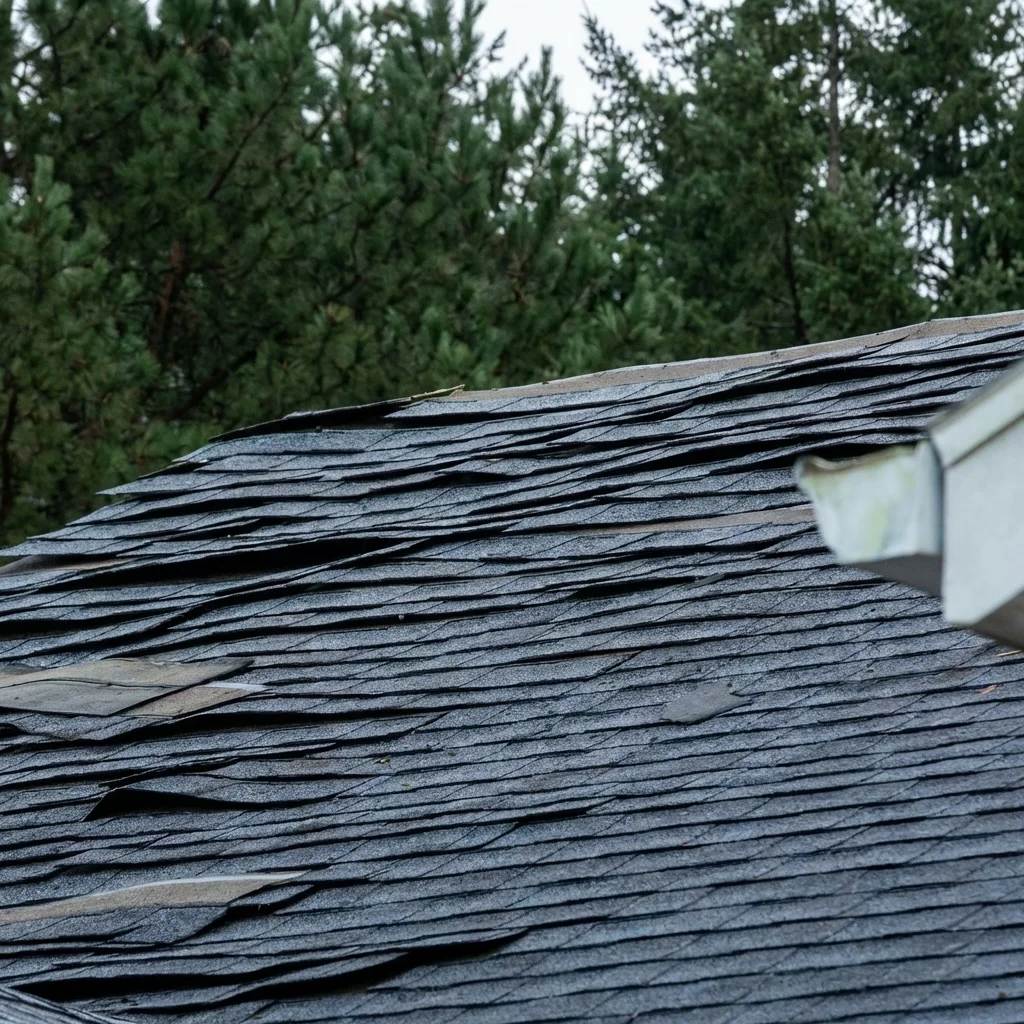
What Wind Does to Your Roof - and How to Spot It Fast
Roof damage from high winds is one of the most common, and most misunderstood, problems Wisconsin homeowners face after a storm.
Here is a quick overview of what to look for:
- Missing or lifted shingles: tabs blown off or peeling up at the edges
- Creased or curled shingles: shingles that look flat but have broken adhesive seals underneath
- Granule loss: dark sandy grit collecting in your gutters or at downspout outlets
- Damaged flashing: loose or bent metal around chimneys, vents, and roof valleys
- Interior water stains: yellow or brown spots on ceilings or upper walls
- Damp attic insulation: moisture or musty smells in the attic after a storm
- Visible daylight in the attic: light peeking through roof boards where there should be none
The tricky part? A roof can look completely fine from your driveway and still have serious hidden damage. Wind does not just blow shingles off. It lifts them, breaks their adhesive seals, and leaves gaps that let in water, sometimes weeks before you notice a leak inside.
Most roofs begin to show damage when winds exceed 45 to 50 mph. In Central Wisconsin, that threshold gets crossed more often than most homeowners realize, through spring thunderstorms, summer derechos, and late-season wind events that do not always make the news.
I'm Bryan Londerville, founder of A-RITE Exteriors, and since 2002 I have helped Central Wisconsin homeowners identify and recover from roof damage from high winds, from minor shingle repairs to full storm damage replacements. In this guide, I will walk you through exactly how wind damages a roof, what signs to look for inside and outside your home, and what steps to take next.

Learn more about roof damage from high winds:
The Physics of Wind Uplift: How Roof Damage from High Winds Occurs
To understand how wind damages a roof, we have to look at the aerodynamics of a storm. Many homeowners assume that wind simply blows against the side of a house and knocks shingles off. In reality, the most destructive force is a phenomenon known as wind uplift.
This process is governed by the Bernoulli principle, which is the same physical law that allows airplanes to fly. As fast-moving wind rushes over your roof line, it is forced to accelerate. This rapid movement creates a pocket of low pressure (a vacuum effect) directly above the roof surface. Meanwhile, the air pressure inside your attic remains normal. This pressure imbalance creates a powerful upward suction force, literally pulling the roofing materials away from the wooden deck.

Wind damage is rarely uniform. It targets the most vulnerable transition points on your roof:
- The Perimeter Edges and Eaves: Wind hits the vertical walls of your home and is forced upward, wrapping around the eaves. This creates intense turbulence at the very edge of your roof.
- The Corners: Corners experience multi-directional wind forces, making them prime targets for the peeling effect.
- The Ridgelines: As wind peaks at the highest point of the roof, the suction force is at its absolute strongest.
Once the wind gets a tiny foothold under a loose edge, it creates a "zipper effect." The wind peels up the first shingle, exposing the next one to direct uplift forces, and quickly strips entire sections of your roof. For a deeper technical dive into how structures react to these forces, the National Roofing Contractors Association offers an excellent guide on Roof Repair After Strong Winds.
Exterior Signs of Roof Damage from High Winds
When we inspect a roof after a severe wind storm in communities like Wausau, Stevens Point, or Minocqua, we look for several distinct visual clues. Some are obvious, while others require a trained eye to spot.
- Missing Shingles: This is the most obvious sign. When wind speeds exceed a shingle's physical rating, the tabs are ripped completely off, exposing the dark underlayment or bare wood deck beneath.
- Lifted Shingles and Broken Seals: Even if a shingle is still lying flat, the wind uplift may have broken the manufacturer’s adhesive sealant strip underneath. Once this bond is broken, the shingle is highly vulnerable to wind-driven rain.
- Curled or Creased Shingles: If wind lifts a shingle tab repeatedly but does not tear it off, the asphalt material will bend and develop a horizontal crease line. These creased shingles are structurally compromised and will eventually break off.
- Granule Loss: Asphalt shingles rely on a top layer of mineral granules to protect them from UV rays. High winds and flying debris strip these granules away, leaving bald, dark spots on your shingles. You will often find these granules piled up in your gutters.
- Damaged Flashing: Flashing is the thin metal installed around chimneys, dormers, and valleys. Wind can easily loosen or bend flashing at speeds as low as 40 to 50 mph, leaving critical joints open to water.
- Loose or Bent Gutters: High winds can pull gutters away from the fascia board, disrupting your home's water shedding system.
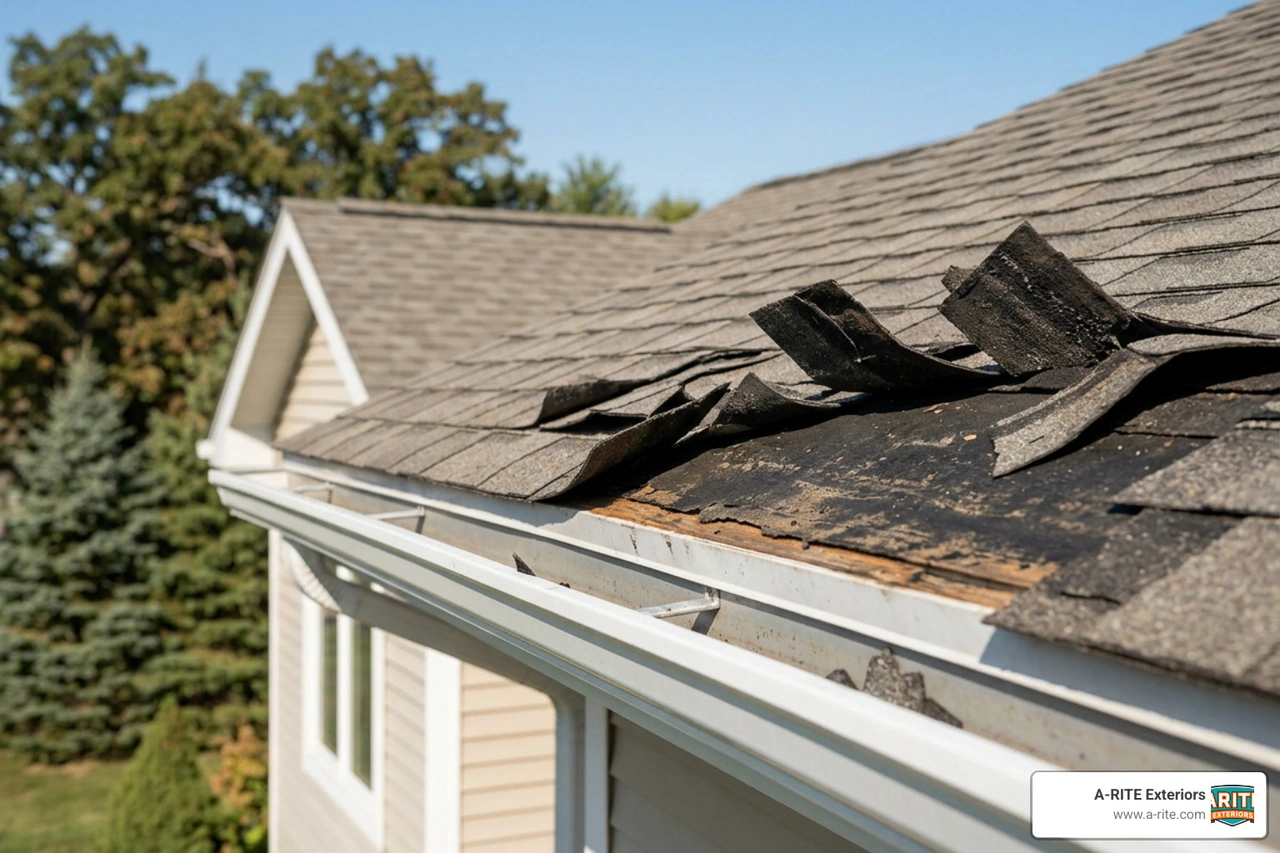
If you notice any of these signs on your home, acting quickly is key to preventing water from rotting your roof deck. You can explore our targeted repair solutions on our Services - Repairs page.
Hidden Interior Signs of Roof Damage from High Winds
You do not always have to climb a ladder to know your roof has taken a beating. In fact, some of the most telling signs of wind damage are hidden inside your attic or living spaces. If a storm has broken the adhesive seals on your shingles, wind-driven rain can find its way under the system.
A proper post-storm attic inspection should look for:
- Water Stains: Look for brown, yellow, or dark rings on your ceiling plaster, drywall, or upper walls.
- Damp or Packed Insulation: Wet fiberglass or cellulose insulation loses its R-value and becomes a breeding ground for structural issues.
- Musty Odors: If your attic suddenly smells damp or musty within 24 to 48 hours of a storm, water has likely penetrated the roof deck.
- Visible Daylight: If you turn off the lights in your attic during the day and see pinpricks of light peeking through the roof boards, your primary weather barrier has failed.
- Rapid Mold Growth: Mold can start colonizing wet wood and drywall within 24 to 48 hours of moisture exposure.

Because water can travel 10 to 15 feet along a rafter before dripping onto your ceiling, finding the exact source of a leak can be incredibly difficult. If you suspect your home has suffered storm damage, read our guide on Who Should I Call for Storm Damage Roof Repair to make sure you get the right local experts on the job.
Material Vulnerability and Wind Resistance Ratings
Not all roofs are created equal when it comes to battling Wisconsin's high winds. The material your roof is made of, its age, and how it was installed play massive roles in whether it survives a storm intact.
When winds howl through the state, local roofers face an immediate surge in service calls, as highlighted in this Milwaukee Roofers News report. The primary goal during any high-wind event is preventing water from getting under the primary roof covering.
A sealed roof deck is one of the best defenses a home can have. According to research from the Institute for Business & Home Safety (IBHS), a sealed roof deck can prevent as much as 90% of wind-driven rain from entering your home through deck joints if the primary shingles fail.
Asphalt Shingles and Wind Ratings
Asphalt shingles are the most common roofing material in Central Wisconsin, but their wind performance varies widely.
- Standard 3-Tab Shingles: These traditional, flat shingles are typical on older homes. They are commonly rated for wind speeds up to 60 mph (ASTM D3161 Class A). Because they are lightweight and have a single layer, they are highly susceptible to lifting and tearing.
- Architectural (Laminated) Shingles: These thicker, multi-layered shingles offer much higher wind resistance. Some architectural shingles are rated up to 110 to 130 mph when installed as part of the required manufacturer system (meeting ASTM D7158 Class H standards).
However, even the highest-rated shingle will fail if it is installed incorrectly. One of the most common installation errors is "high-nailing," where the installer places the nails above the designated nail line. A single high nail can reduce a shingle's wind rating by up to 50%, allowing moderate winds to easily rip it away.
To learn more about high-quality asphalt options, visit our Services - Roofing page.
Metal, Tile, and Alternative Roofing Materials
While asphalt is popular, alternative materials offer unique pros and cons in high-wind environments:
- Metal Roofing: Standing seam metal roofs are exceptionally wind-resistant, commonly rated to withstand winds of 110 to 120 mph. However, they are not invincible. If fasteners are spaced too far apart or if fastener seals degrade over time, wind can get under the panels and cause severe structural peeling.
- Concrete Tile: While incredibly heavy and durable, tile roofs rely heavily on the underlayment beneath them. High winds can lift tiles, causing underlayment failure even if the tiles themselves look undamaged. Additionally, older tile roofs can suffer from wind scouring, which degrades the protective surface over time.
Post-Storm Action Plan: Safety, Documentation, and Insurance
If a severe wind storm has just swept through your neighborhood, taking structured, immediate action can help reduce the risk of secondary water damage and make the insurance claim process seamless.
Safe Ground-Level Inspections
First and foremost: safety first. Do not climb onto your roof to inspect for damage. Ladder falls cause over 500,000 injuries and roughly 300 deaths annually in the United States. A storm-damaged roof structure may be physically unsound, and wet shingles are incredibly slick.
Instead, conduct a safe ground-level inspection:
- Grab Binoculars: Walk around the perimeter of your yard and use binoculars to inspect the roof edges, valleys, and ridgelines.
- Look for Collateral Damage: Check your air conditioning condenser fins, metal mailboxes, and siding for impact marks or dents. If these ground-level items are damaged, your roof likely took a hit too.
- Check Your Gutters and Downspouts: Look for loose brackets, sagging sections, or piles of accumulated shingle granules at the bottom of your downspout splash blocks.
Documenting Damage for Insurance Claims
If you spot signs of wind damage, you need to build a comprehensive paper trail for your insurance company.
- Take Photos and Videos: Take wide-angle shots of your entire home to provide context, followed by medium and close-up detail photos of the specific damage. Ensure your photos are timestamped.
- Record the Storm Date: Note the exact date and time the high winds occurred. Local weather reports confirming wind speeds in your town (such as Mosinee, Wisconsin Rapids, or Tomahawk) will support your claim.
- Keep a Call Log: Document every conversation you have with your insurance company, adjusters, and contractors.
- Understand Your Policy: Confirm whether you have an Actual Cash Value (ACV) policy (which pays depreciated value based on roof age) or a Replacement Cost Value (RCV) policy (which covers the actual cost of a modern replacement).
If your insurance adjuster's assessment differs from your contractor's estimate, you have the right to request a joint reinspection, where both parties meet on your roof to resolve discrepancies.
Repair vs. Replacement: Evaluating the Cost of Delay
Ignoring minor wind damage is an expensive gamble. What starts as a single lifted shingle can escalate into a structural disaster over a couple of seasons. Water will slowly rot your roof decking, ruin your insulation, and allow mold to colonize your home.
In Wisconsin winters, wind-damaged shingles also invite ice dams. When heat escapes through damaged insulation, it melts snow on your roof, which refreezes at the cold eaves, trapping water and forcing it directly into your home.
| Indicator | Minor Repair | Full Roof Replacement |
|---|---|---|
| Scope of Damage | Localized to one slope or a few shingles | Widespread across multiple slopes (over 25%) |
| Adhesive Seal Integrity | Seals are intact across the rest of the roof | Widespread seal failure (zipper effect) |
| Roof Age | Under 10-12 years old | Over 15 years old |
| Material Availability | Matching shingles are readily available | Shingles are discontinued or badly faded |
| Decking Condition | Solid, dry, and structurally sound | Soft spots, rot, or water-logged plywood |
When to Repair vs. Replace
The choice between spot repairs and a full replacement usually comes down to the age of your roof and the extent of the damage. If less than 25% of a single roof slope is damaged, a professional repair is often the most sensible path.
However, if your roof is over 15 years old or the "zipper effect" has broken the seals across multiple slopes, a full replacement is the safer, more cost-effective long-term investment.
A full roof replacement typically ranges from the upper four figures to mid five figures. The final price depends on several factors, including:
- The overall size and architectural complexity of your roof
- The pitch (steepness) of the slopes
- The number of existing shingle layers that need to be torn off
- Whether the underlying plywood decking needs to be replaced
- The specific roofing materials and labor required for installation
To understand the replacement process in Central Wisconsin, read our guide to Local Roof Replacement.
Financial Considerations, Rebates, and Financing
Addressing storm damage can cost thousands of dollars, and severe cases can cost much more. When comparing estimates, keep in mind that a lower price may reflect differences in materials, scope, cleanup, warranty coverage, or installation details.
To help make your project manageable, A-RITE Exteriors offers flexible payment solutions. Financing options are available for qualifying homeowners. Loan amounts up to $100,000 unsecured may be available, with final approval, rates, and terms based on lender review and credit qualification.
Additionally, homeowners may qualify for Focus on Energy rebates. Please note that these rebates are specifically for qualifying insulation and air-sealing work (such as attic insulation, air sealing, wall insulation, foundation insulation, duct sealing, and qualifying DIY attic insulation and air sealing), not for the roof replacement itself. Rebate amounts and eligibility rules change over time, so we always recommend confirming current program rules with Focus on Energy before starting work.
Note regarding tax credits: The Section 25C Energy Efficient Home Improvement Credit was available for qualifying improvements placed in service through December 31, 2025. Always recommend consulting a tax professional to see what active federal or state incentives apply to your project.
Frequently Asked Questions about Wind Damage
What wind speeds cause roof damage?
While many modern shingles are rated for high winds, actual roof damage from high winds can begin at speeds as low as 45 to 50 mph.
- 45-50 mph: Can loosen roof flashing, lift aged shingles, and break weak adhesive seals.
- 55-70 mph: Can cause moderate damage, ripping off shingle tabs and lifting ridge caps.
- 70+ mph: Can cause severe structural damage, peeling away large sections of shingles and exposing bare roof decking.
Does homeowners insurance cover wind damage?
Yes, standard homeowners insurance policies typically cover sudden and accidental damage caused by windstorms, tornadoes, and hurricanes. However, you are still responsible for your policy's deductible. It is critical to file your claim within your policy's designated deadlines to avoid claim denial due to neglect.
How can I prevent wind damage to my roof?
Preventive maintenance is your best defense:
- Trim Overhanging Trees: Keep branches trimmed at least 10 feet away from your roof line so they do not act as battering rams during high winds.
- Schedule Regular Inspections: Have a professional inspect your roof before and after storm season to catch loose shingles or failing flashing early.
- Choose Wind-Resistant Materials: When replacing your roof, invest in Class H architectural shingles and ensure your contractor uses a proper 6-nail fastening pattern.
Conclusion
Your roof is your home's first line of defense against Central Wisconsin's unpredictable weather. From heavy snow loads in Tomahawk and Minocqua to intense summer wind storms in Wausau and Stevens Point, your roofing system takes a beating year-round.
If a recent storm has crossed your path, do not wait for a ceiling stain to tell you there is a problem. A-RITE Exteriors is here to provide honest, local, and professional storm damage restoration services. Trust the Hawk on Your Block to keep your home safe, dry, and comfortable.
Ready to secure your home's envelope? Contact us today to schedule a professional roof inspection, or explore our A-RITE Exteriors Insulation Services to keep your attic dry and energy-efficient all year long.