What Hidden Cut Corners Are Built Into a Cheap Roofing Bid?
When an estimate comes in significantly below local market averages across Marathon, Oneida, or Portage counties, it is rarely because one contractor pays half as much for asphalt shingles or roofing nails. A lower price may reflect differences in materials, scope, cleanup, warranty coverage, or installation details. In many cases, an unusually low bid simply leaves out standard protective components to present an appealing bottom-line number.
Here are the most common scope items that get cut to make a proposal appear cheap upfront:
- Reusing Worn Flashing and Accessories: Quality installations replace step flashing, wall flashing, chimney flashing, drip edges, and rubber pipe boots. Low bids often plan to leave old, rusted, or bent metal in place, smearing sealant over tired joints to save on material and labor.
- Omitting Ice and Water Shield: In Central Wisconsin, severe freeze-thaw cycles make self-adhering waterproof underlayment essential along eaves, valleys, rake edges, and around roof penetrations. Low proposals often skip ice and water membrane altogether or install a bare minimum strip along the gutters.
- Downgrading Underlayment and Shingles: Instead of tear-resistant synthetic underlayment, low quotes often specify standard felt paper or thin builder-grade 3-tab shingles. In extreme cases, cut-rate bidders source closeout lots or "seconds" bundles that suffer from pre-existing granulate loss or distinct shade mismatches.
- Skipping the Tear-Off: Laying new shingles directly over old roofing saves significant disposal and labor costs, but it conceals rot and doubles heat retention. To understand why this shortcut causes long-term headaches, read our guide on Why You Should Not Roof Over Existing Shingles.
- Ignoring Decking Inspections: A low proposal usually assumes every sheet of plywood or OSB is pristine. When workers discover soft or rotted wood during tear-off, the contractor must either shingle directly over structural decay or hit the homeowner with unexpected change orders.
- Vague, Non-Itemized Scope: Lump-sum quotes that simply state "Replace roof" allow contractors to substitute cheaper accessories, omit permits, or charge extra for dumpster rental and magnetic lawn sweeps.
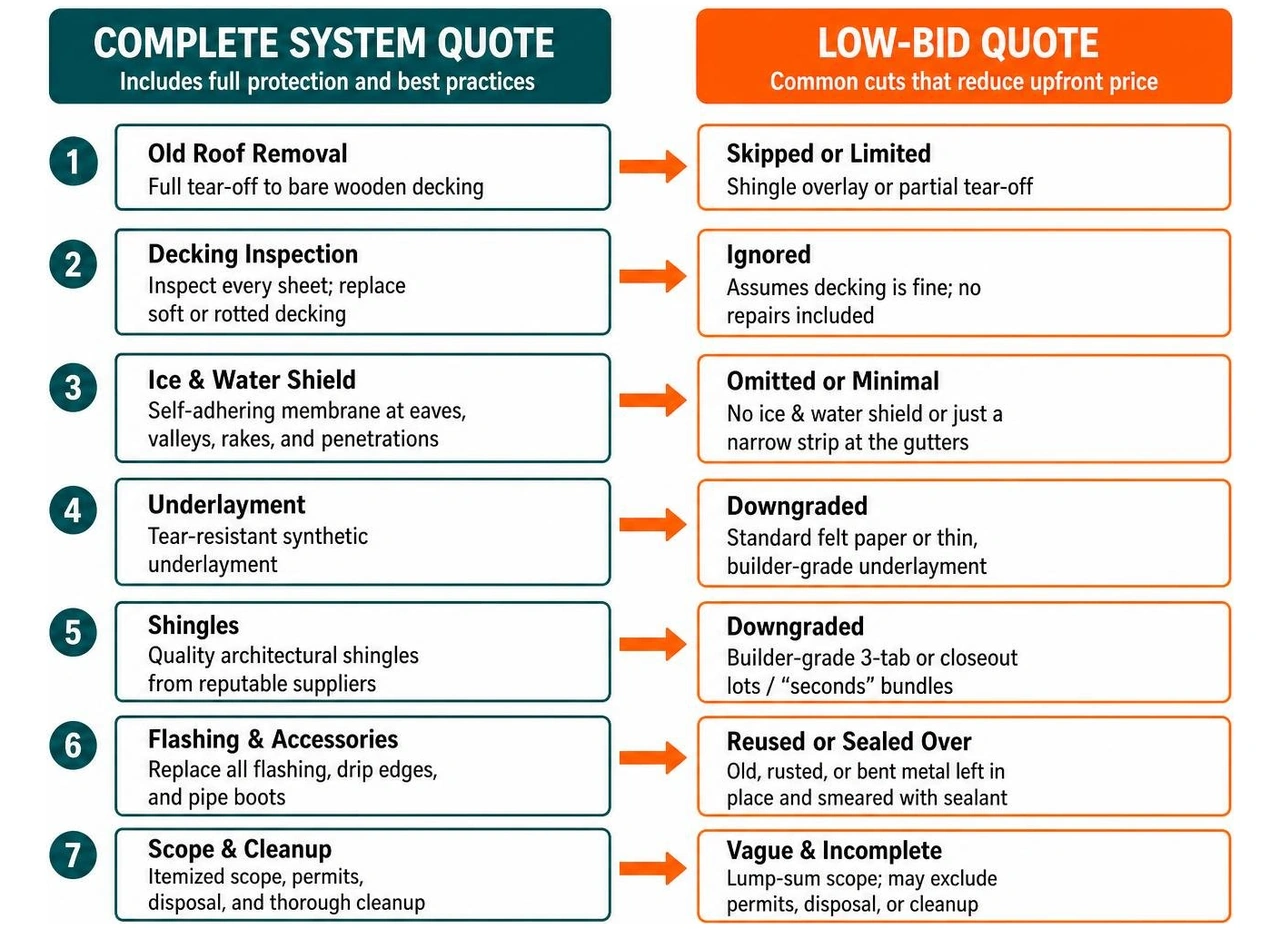
To see how these hidden cuts accumulate, consider the direct comparison between a complete roof system and a stripped-down bid:
| Roofing Component | Complete System Quote | Low-Bid Quote |
|---|---|---|
| Old Roof Removal | Full tear-off to bare wooden decking | Shingle overlay or partial tear-off |
| Deck Inspection | Inspection of all plywood/OSB & replacement of bad boards | New shingles nailed over unseen decay |
| Eave & Valley Protection | High-tack ice & water shield along all critical edges | Standard felt paper or single narrow strip |
| Underlayment Grade | Heavy-duty breathable synthetic underlayment | Thin 15 lb organic felt paper |
| Flashing & Metalwork | New custom metal flashing at chimneys, walls, & pipes | Reused old metal with topical caulk |
| Fastener Standard | 6-nail pattern with full pneumatic depth control | 4-nail pattern or overdriven staples |
| Ventilation Integration | Calculation & installation of balanced intake/exhaust | Old static vents left unverified |
| Property Cleanup | Roll-off container, tarping, & magnetic nail sweep | Minimal cleanup or extra dumping fees |
How Do Low-Quality Materials and Installation Shortcuts Lead to Early Failure?
Even high-grade shingles will fail prematurely if they are installed with speed-focused shortcuts. When a crew is rushed to complete two or three roofs in a day to turn a profit on narrow margins, installation quality suffers in areas that homeowners cannot see from the ground.
One critical shortcut involves shingle fastening. Industry standards require pneumatic nail guns to be calibrated so fasteners land flat against the shingle's designated nailing strip. When a low-bid crew rushes, nails are frequently overdriven through the mat or underdriven so the heads stick up. Overdriven nails allow wind uplift to rip shingles directly off the deck, while underdriven nail heads puncture the overlapping shingle above them. Furthermore, while standard application uses four nails per shingle, high-wind zones demand six nails. Proper fastening is vital because some architectural shingles are rated up to 110 to 130 mph when installed as part of the required system, a rating that becomes completely void if fastening patterns are compromised.
In Central Wisconsin communities like Minocqua, Tomahawk, and Stevens Point, winter weather exposes these installation flaws quickly. Heavy snow accumulation creates continuous moisture contact along roof eaves. If a low bid omitted ice and water shield or reused old valley flashing, meltwater gets drawn upward beneath the shingles by capillary action during freeze-thaw cycles.
Skipping ventilation updates is another severe shortcut. Asphalt shingles require continuous air movement through attic soffit intake vents and ridge exhaust vents to regulate temperature. Without balanced air movement, summer heat buildup cooks shingles from underneath, causing blistering and excessive granule loss. In winter, trapped heat melts snow on the roof deck, feeding massive ice dams along uninsulated eaves.
When water breaches compromised underlayment or improperly sealed nails, structural decay sets in quietly behind drywall and insulation. According to building standards maintained by organizations like the International Code Council (ICC) and the National Roofing Contractors Association (NRCA), deferred structural repairs from unchecked leaks can cost thousands of dollars, and severe cases can cost much more. Choosing components specifically suited to midwestern weather is essential, as detailed in our analysis of What Is the Best Roofing System for Wisconsin Weather.
What Legal and Financial Liabilities Do Uninsured Contractor Bids Create?
A price that seems extraordinarily cheap often reflects a contractor operating without full administrative overhead, required municipal licenses, or comprehensive insurance coverage. While skipping overhead allows a low bidder to offer attractive pricing, it transfers immense financial and legal risk directly onto the property owner.
Legitimate roofing contractors maintain two core insurance policies: General Liability Insurance (which covers accidental damage to your home, siding, landscaping, or interior during construction) and Workers' Compensation Insurance (which covers medical expenses and lost wages if a worker falls or suffers injury on your property).
In the construction industry, workers' compensation rates for elevated trades like roofing represent a substantial percentage of total payroll. For example, regulatory data from Washington State shows workers' compensation rates for roofers are $5.80 per hour per employee. Uninsured or underinsured contractors frequently lower their labor rates by skipping this coverage or misclassifying workers as independent sub-contractors. If an uninsured worker slips on an icy roof deck in Weston or Grand Rapids, the worker's primary legal recourse for medical expenses and disability claims may fall directly against your homeowner's insurance policy.
Building permit compliance is another area where low bidders cut corners. Municipalities like Wausau, Green Bay, and Wisconsin Rapids enforce local building codes through permit inspections to confirm wind uplift standards, ice barrier requirements, and proper ventilation. Low-bid contractors often skip permits to save the fee and avoid third-party code scrutiny. When you go to sell your home later, an unpermitted roof installation can trigger failed home inspections, municipal fines, or required retrofits.
Finally, industry turnover data from business tracking sources demonstrates that roughly 80% of roofing companies close or change business names within their first five years. Many low bidders are temporary outfits or door-to-door operators who flood storm-damaged regions and disappear when warranty claims arise. Learn how to protect your home by reviewing our guide on How Do I Choose a Trustworthy Roofer in Wisconsin and Avoid Storm Chasers.
Why Will a Cheap Roofing Bid Leave You Without Real Warranty Protection?
Homeowners reviewing a low bid are often shown impressive phrases like "50-Year Material Warranty" or "Lifetime Shingle Protection." However, there is a fundamental difference between a Manufacturer Material Warranty and a Contractor Workmanship Warranty.
A manufacturer material warranty covers factory defects in the physical shingle product. It does not cover installation errors, water intrusion from misaligned flashing, or leaks caused by bad nailing patterns. In fact, major shingle manufacturers like GAF and Owens Corning strictly state in their warranty terms that improper installation, inadequate attic ventilation, or failure to use required system accessories will void the material warranty entirely. If a cheap bidder misnails shingles or skips underlayment, the manufacturer will deny your defect claim.
A contractor workmanship warranty covers the installation labor itself. However, a 10-year craftsmanship guarantee written on a cheap quote is only as reliable as the company behind it. If a low bidder operates on unsustainable margins and closes business within two or three years, your written workmanship guarantee becomes completely worthless.
Established contractors invest heavily in earnable manufacturer certifications, such as CertainTeed SELECT ShingleMaster or GAF Master Elite status, which are granted to top-tier installers with verified licensing, insurance, and longevity. Certified contractors can offer factory-backed enhanced warranties that cover both materials and installation labor for decades, even if the installer ever leaves the trade. To examine similar bidding dynamics in metal systems, read this detailed breakdown on Low Metal Roofing Bids: 7 Reasons the Lowest Bid Could Cause Problems.
How Does a Cheap Roof Affect Home Resale Value and Insurance Claims?
A roof is one of the first structural items examined by real estate agents, home inspectors, and insurance underwriters. Accepting a cheap proposal can create significant friction when you decide to sell your property or file a storm claim.
During a real estate transaction in communities like Plover, Kronenwetter, or Rib Mountain, a buyer's home inspector will walk the roof deck and evaluate attic space. Common flaws from low-bid installations, such as uneven shingle courses, missing drip edge along rake lines, rusted chimney flashing, or unvented soffits, are highlighted in red on inspection reports. Buyers routinely demand multi-thousand dollar credit concessions or insist on complete roof replacement prior to closing when faced with poor craftsmanship.
Insurance claims introduce additional complications. Following severe hailstorms or high-wind events, insurance adjusters inspect damaged roof systems. If an adjuster discovers that previous storm repairs were performed poorly, such as laying new shingles over rotten wood or skipping starter strips, the insurance company may deny coverage for interior water leaks, attributing the loss to pre-existing installation defects rather than sudden storm damage.

To avoid these traps when reviewing proposals, ask every contractor these seven essential vetting questions:
- Will you perform a complete tear-off down to the bare wooden deck, or are you overlaying shingles?
- Does your quote explicitly include new drip edge, new wall/chimney flashing, and new pipe boots?
- What exact brand and grade of synthetic underlayment and ice/water shield are included?
- Are you pulling a local municipal building permit, and is that fee included in the price?
- Can you provide current certificates for General Liability and Workers' Compensation insurance directly from your insurer?
- What specific manufacturer certifications do your installation crews hold?
- What is the duration of your written workmanship warranty, and who physically performs the labor if a leak occurs in year three?
For additional contractor screening criteria, read our complete guide on How Do I Choose a Roofing Contractor in Central Wisconsin.
What Are the Frequently Asked Questions About Low Roofing Bids?
Is a lower roofing bid ever a legitimate deal?
A lower proposal can sometimes reflect operational efficiency rather than compromised quality. For example, an established local contractor who buys high material volumes directly from distributors, manages streamlined in-house crews, or operates with modest sales commissions may offer a very competitive price.
The key is distinguishing between a fair market estimate from a well-run business and an artificially low bid. A legitimate deal will still include a fully itemized scope of work, complete tear-off, high-grade underlayment, new flashing, full insurance certificates, municipal permits, and explicit warranty coverage. If a quote is 25% to 40% below all other local bids while leaving out itemized material descriptions, it almost certainly reflects omitted protection.
Why do roofing estimates vary so dramatically for the same house?
Roofing quotes vary dramatically because contractors are rarely quoting the exact same product or installation process. A full roof replacement is a complex system involving tear-off labor, disposal fees, structural deck repairs, leak barriers, synthetic underlayments, starter shingles, field shingles, hip/ridge caps, flashing metal, and ventilation hardware.
Across typical residential properties in Central Wisconsin, complete roof replacement costs typically range from upper four figures to mid five figures. Final pricing depends heavily on overall roof size, slope/pitch, height, number of existing layers to tear off, decking condition, selected material grades, and labor standards. A low-cost proposal typically represents a "lighter" scope of work with basic materials, whereas a comprehensive proposal accounts for long-term weather resistance, full property protection tarps, magnetic nail cleanup, trained supervisory staff, and long-term warranty backing.
When managing roof replacement expenses, homeowners often explore payment options. Financing options are available for qualifying homeowners. Loan amounts up to $100,000 unsecured may be available, with final approval, rates, and terms based on lender review and credit qualification.
Regarding tax incentives, IRS guidance showed that Section 25C (the Energy Efficient Home Improvement Credit) was available through December 31, 2025; property owners should consult a tax professional regarding current federal tax credit rules for energy-efficient home improvements.
For energy efficiency rebates in Wisconsin, homeowners may qualify for Focus on Energy rebates. Focus on Energy incentives apply strictly to qualifying insulation and air-sealing measures (such as attic insulation, air sealing, wall insulation, foundation insulation, duct sealing, and qualifying DIY attic insulation and air sealing) and do not apply to roof replacement itself. Rebate amounts and eligibility rules change over time, and homeowners should confirm current program rules before starting work. While Focus on Energy supports various insulation measures across a building envelope, A-RITE Exteriors specifically provides attic insulation to complement roofing installations.
What hidden fees commonly pop up after accepting a cheap proposal?
Low bidders frequently use simplified, low-ball quotes to win contracts, expecting to regain profit through mid-project upcharges once your old shingles are stripped off.
The most common hidden fees include:
- Plywood Decking Charges: Unpriced or heavily marked-up fees per sheet when replacing soft roof decking.
- Dumpster and Waste Fees: Extra invoices for waste hauling, heavy material disposal, or shingle recycling fees.
- Flashing Retrofits: Upcharges for custom metalwork around chimneys or dormers that was omitted from the initial quote.
- Permit Fees: Passing municipal permit fees back to the homeowner as a separate add-on charge.
Unaddressed leaks or hidden decay resulting from poor initial work can lead to extensive ceiling and wall damage. Repairing structural timber decay or interior drywall mold can cost thousands of dollars, and severe cases can cost much more.
Conclusion: How Do You Choose Long-Term Value Over a Low Upfront Price?
When evaluating roofing proposals for your home, the true cost of a roof is measured over its entire operational lifespan, not just by the total listed on the initial estimate. A cheap bid that saves money on day one but requires constant leak repairs, causes attic mold, or mandates a full secondary replacement in year seven is vastly more expensive than a properly engineered installation that typically lasts for decades.
At A-RITE Exteriors, we have spent over two decades helping homeowners across Central Wisconsin, including Wausau, Schofield, Merrill, Minocqua, Weston, Mosinee, and surrounding towns, protect their properties with weather-resistant exterior solutions. We build roof systems designed specifically for severe winter conditions, heavy snow loads, and summer ice dams.
Our complete roof replacements are paired with balanced attic ventilation, heavy-duty underlayment systems, new custom metal flashing, and high-performance architectural shingles. Beyond complete roofing services, our team provides integrated exterior protection, including seamless gutters, durable siding, energy-efficient replacement windows, and professional attic insulation.
Before accepting a quote that seems too good to be true, get an honest, itemized assessment of your home's needs. Use our Instant Roof Quote Tool or contact A-RITE Exteriors today to schedule a thorough, transparent consultation. Trust the Hawk on Your Block to protect your home for decades to come.