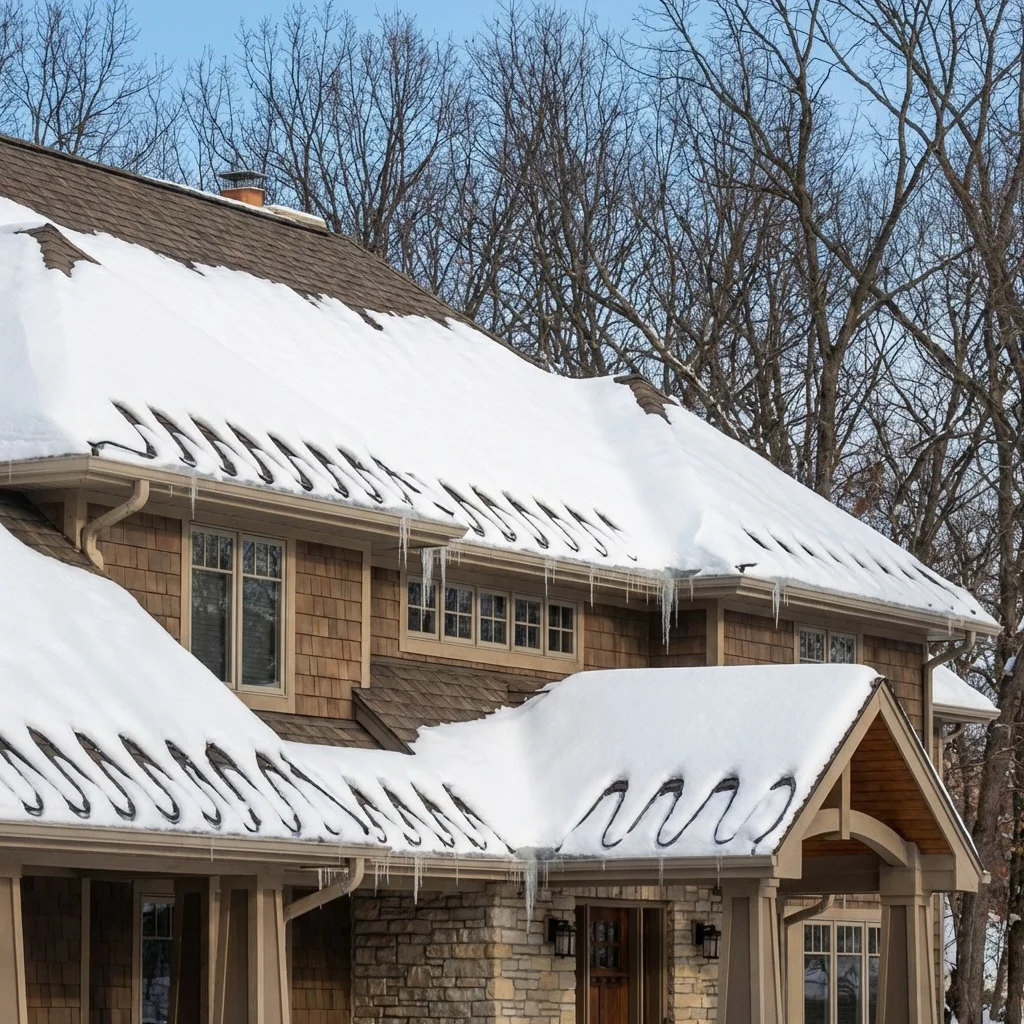
Why the R Factor for Wisconsin Homes Can Make or Break Your Winter
Understanding the r factor for Wisconsin homes is one of the most practical things you can do before the next hard freeze arrives. If your attic is losing heat faster than your furnace can replace it, you are paying for warmth that never stays.
Here is a quick answer to what most Wisconsin homeowners want to know:
| Location | Minimum Code (SPS 322) | ENERGY STAR Recommended |
|---|---|---|
| Attic (uninsulated) | R-49 | R-60 |
| Attic (existing 3-4") | R-49 | R-49 |
| Wood frame walls (Zone 6) | R-20 or R-13+5 | R-20 to R-25 |
| Wood frame walls (Zone 7) | R-21 or R-19+5 | R-20 to R-25 |
| Basement / crawl space walls | R-15 continuous or R-19 batt | R-15 to R-19 |
| Floors over unconditioned space | R-30 (Zone 6) / R-38 (Zone 7) | R-30 to R-38 |
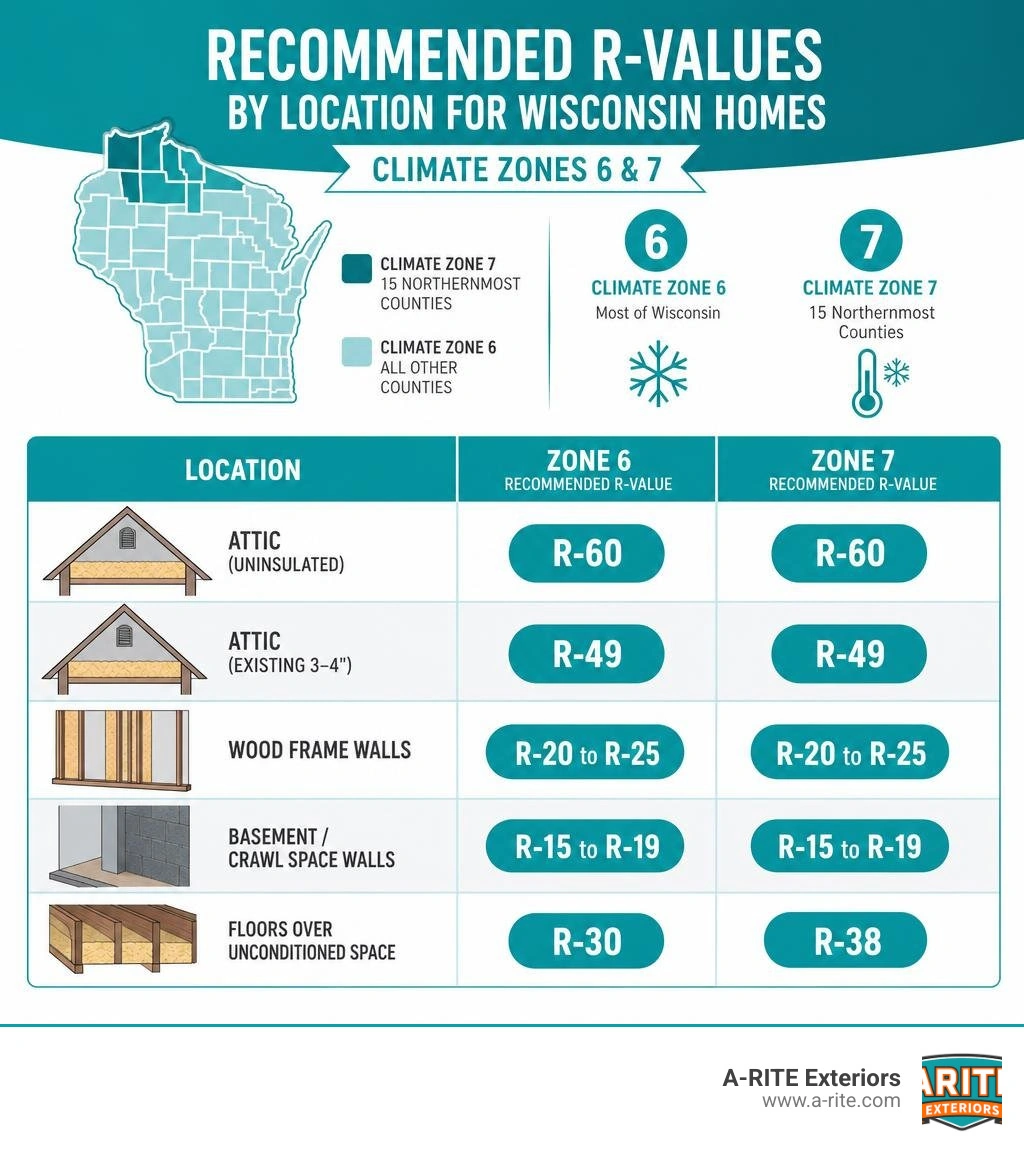
Most of Wisconsin sits in Climate Zone 6. The 15 northernmost counties — including Vilas, Oneida, Lincoln, and Iron — fall into the colder Climate Zone 7. Both zones demand high insulation levels, but Zone 7 requirements are slightly stricter.
Wisconsin winters are not mild. Summer highs can top 90°F in some parts of the state, and winter lows regularly drop below zero. The swing between those extremes puts serious stress on your home's thermal envelope every single year. Without adequate insulation, heat escapes through your attic, walls, and floors — and your energy bills reflect every degree lost.
I'm Bryan Londerville, founder of A-RITE Exteriors, and since 2002 I've helped Central Wisconsin homeowners protect their homes from the outside in — including attic insulation upgrades where the r factor for Wisconsin homes is often far below what it should be. The guide below walks you through exactly what your home needs, zone by zone, room by room.
Handy r factor for wisconsin homes terms:
Demystifying the R Factor for Wisconsin Homes
When we talk about the r factor for Wisconsin homes, we are dealing with a material's capacity to resist heat flow. In the insulation industry, this is officially known as "R-value." If you have ever wondered what R-value means and why it's important for insulation, the concept is actually quite straightforward: the "R" stands for resistance.
Heat is a restless traveler. It moves from warm areas to cold areas in three distinct ways:
- Conduction: Heat moving directly through solid materials (like wood studs or drywall).
- Convection: Heat traveling through air currents (like warm air rising toward your roof deck).
- Radiation: Heat traveling in a straight line, warming any solid object in its path (like the sun beating down on your asphalt shingles).
Insulation works by slowing down conduction and convection. The higher the R-value of a material, the better it is at stopping this heat transfer.
Understanding what is r-factor insulation helps explain why your home can feel drafty even when the thermostat is cranked up. During a brutal winter freeze in Stevens Point or Wausau, the heat inside your living room tries to escape into the freezing air outside. In the summer, the reverse happens: the hot air in your attic tries to force its way down into your air-conditioned living spaces.
By maintaining a high R-value, you create a robust thermal barrier. This directly translates to better energy efficiency, reduced wear and tear on your HVAC system, and a level of home comfort that keeps your family cozy regardless of what the weather is doing outside.
Recommended R-Values Across Wisconsin Climate Zones
To get the most out of your home improvement projects, you need to tailor your insulation choices to your specific region. If you are asking yourself what R-value insulation do I need for attic spaces, the answer depends on where you live and whether you are starting from scratch or retrofitting an older property.
The U.S. Department of Energy (DOE) and ENERGY STAR lay out clear guidelines for residential properties. Here is a detailed breakdown of the recommended R-values for different parts of your home:
| Home Area | Climate Zone 6 (e.g., Wausau, Stevens Point, Green Bay) | Climate Zone 7 (e.g., Minocqua, Lac du Flambeau) |
|---|---|---|
| Uninsulated Attic | R-60 | R-60 |
| Attic with Existing Insulation | R-49 | R-49 |
| Exterior Walls (2x4) | R-13 to R-15 | R-13 to R-15 |
| Exterior Walls (2x6) | R-19 to R-21 | R-19 to R-21 |
| Floors over Crawl Spaces | R-25 to R-30 | R-38 |
| Basement Walls | R-15 (sheathing) or R-19 (batts) | R-15 (sheathing) or R-19 (batts) |
These recommendations are designed to optimize your home's thermal performance. While minimum building codes establish a baseline for safety and basic efficiency, aiming for these higher target values is often the smartest move for long-term energy savings.
Understanding the R Factor for Wisconsin Homes in Climate Zones 6 and 7
Wisconsin is divided into two distinct climate zones. Climate Zone 6 covers the vast majority of the state, including Central and Eastern Wisconsin communities like Wausau, Schofield, Weston, Kronenwetter, Stevens Point, Plover, and Green Bay.
Climate Zone 7 covers the northernmost 15 counties, which includes communities like Minocqua, Lac du Flambeau, Arbor Vitae, Woodruff, and Tomahawk. This northern region is classified as USDA Hardiness Zone 6A and is defined by the Office of Energy Efficiency and Renewable Energy as "Very Cold."
Because Northern Wisconsin experiences prolonged sub-zero temperatures and massive snow loads, the demand on your home's thermal envelope is relentless. In Zone 7, a higher R-value for floors (R-38 versus Zone 6's R-30) is highly recommended to protect your plumbing and keep floors warm. No matter which zone your home belongs to, preparing for these temperature extremes is the key to preventing high utility bills.
Wisconsin Building Code Requirements (SPS 322)
If you are building a new home or undertaking a major addition in towns like Mosinee, Merrill, or Wisconsin Rapids, you must comply with the state's official building codes. Under the Wisconsin Legislature: CR 15-041 Rule Text, Chapter SPS 322 of the Uniform Dwelling Code (UDC) governs the thermal envelope standards for residential dwellings.
Wisconsin's energy code is designed to ensure that homes are constructed with a continuous, airtight thermal barrier. Here are some of the key administrative rules you should know:
- The Insulation Certificate: Wisconsin law requires a permanent certificate to be posted on or immediately adjacent to the electrical distribution panel. This certificate must detail the specific R-values of the insulation installed in your ceilings, walls, and foundation, as well as the U-factors of your windows and doors.
- Depth Markers: When loose-fill or blown-in insulation is installed in an attic, contractors must place physical thickness markers throughout the space. There must be at least one marker for every 300 square feet, featuring numbers at least one inch tall facing the attic access hatch.
- Attic Access Covers: Any hatch or door leading from a conditioned space to an unconditioned attic must be fully weatherstripped and insulated to a level equivalent to the surrounding ceiling insulation.
- Vapor Retarders: A vapor retarder is required on the warm-in-winter side of your walls and ceilings to prevent indoor moisture from migrating into the cold wall cavities and condensing.
- Blower Door Testing: New homes must undergo testing to ensure the building envelope is sufficiently tight, with air leakage restricted to less than 7 air changes per hour (ACH) at 50 Pascals.
Meeting the R Factor for Wisconsin Homes Under SPS 322
Under the prescriptive path of SPS 322, there are specific legal minimums that must be met for a home's thermal envelope:
- Ceilings and Attics: A minimum of R-49 is required across all Wisconsin zones. However, if you are using uncompressed insulation that extends fully over the wall top plates at the eaves, R-38 is permitted to satisfy the ceiling requirement at the outer edges.
- Wood Frame Walls: In Climate Zone 6, the code requires a minimum of R-20 cavity insulation, or a combination of R-13 cavity insulation plus R-5 continuous insulated sheathing (often written as 13+5). In Climate Zone 7, this requirement steps up to R-21 cavity insulation or a 19+5 configuration.
- Basement and Crawl Space Walls: These must meet the "15/19" rule. This means you must install either R-15 continuous insulated sheathing on the interior or exterior of the wall, or R-19 cavity insulation on the interior.
- Slab Insulation: Unheated slabs require a minimum of R-15 perimeter insulation extending down to a designated depth.
- Wind Wash Protection: To prevent cold winter winds from blowing through your attic insulation and reducing its effective R-value, the code requires air-permeable insulation to be covered on its cold side with a low-permeability material (like house wrap or wood sheathing) at the eaves.
Best Insulation Materials for Cold Climates
Choosing the right material is just as important as hitting your target R-value. Different materials offer different R-values per inch of thickness, and each behaves differently when exposed to Wisconsin's cold, humid winters.
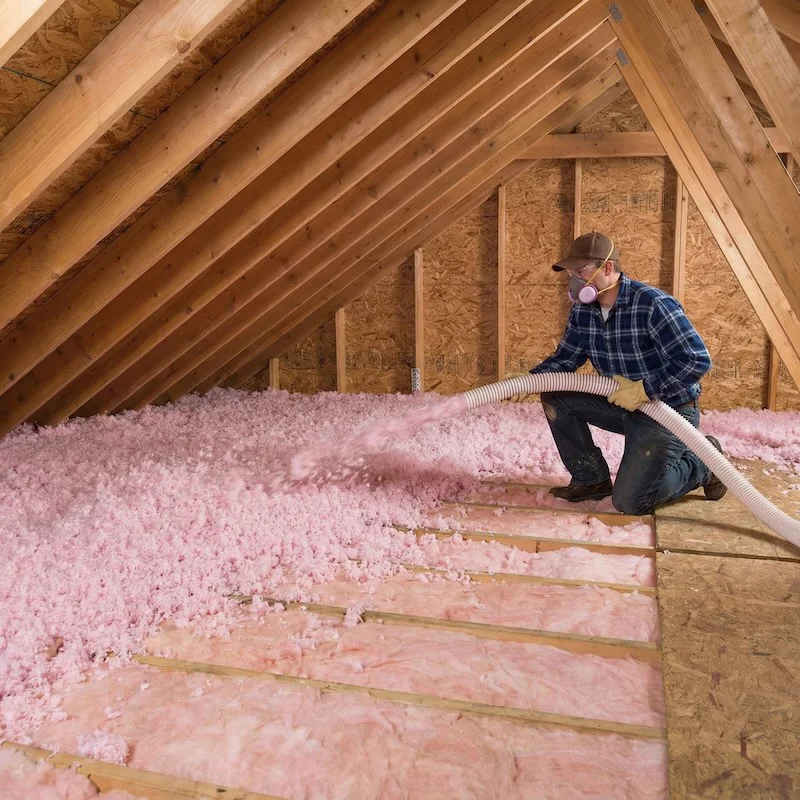
Here is a look at the most common insulation materials we use in Central Wisconsin:
- Fiberglass Batts (R-3.8 to R-4.3 per inch): The traditional pre-cut blankets that fit between wall studs and attic joists. They are affordable and easy to install, but they must be cut precisely to avoid gaps that allow air to bypass the insulation.
- Blown-In Fiberglass (R-2.3 to R-3.8 per inch): Loose fibers blown into attics or wall cavities using a specialized machine. It is excellent for filling tight corners, irregular spaces, and hard-to-reach areas around attic trusses.
- Blown-In Cellulose (R-3.1 to R-3.8 per inch): Made primarily from recycled newspaper treated with fire and pest retardants. It is denser than fiberglass and does a fantastic job of blocking airflow and dampening sound.
- Mineral Wool / Rockwool (R-3.3 to R-4.2 per inch): Spun from volcanic rock and slag. It is highly resistant to fire, moisture, and pests, and it maintains its shape and R-value even if it gets wet.
- Rigid Foam Board (R-3.6 to R-8.0 per inch): Offers the highest R-value per inch. It is commonly used as exterior sheathing to eliminate "thermal bridging" — which occurs when heat bypasses cavity insulation by traveling directly through the wooden wall studs.
Pros and Cons of Spray Foam in Northern Wisconsin
Spray foam insulation is a popular choice for high-performance homes, but it requires careful scientific consideration when applied in colder regions like Minocqua, Tomahawk, or Lac du Flambeau.
- Closed-Cell Spray Foam (R-6.0 to R-7.0 per inch): This is a highly dense material that expands to fill gaps, creating both a thermal barrier and an air/vapor barrier. Because of its high R-value per inch, it is perfect for tight spaces like rim joists or cathedral ceilings.
- Open-Cell Spray Foam (R-3.6 to R-3.9 per inch): This material is much lighter and more flexible. However, open-cell spray foam is generally not recommended for unconditioned spaces in Wisconsin because it is vapor-permeable. Without an additional vapor retarder, winter moisture can pass through it and condense against cold roof decks or wall sheathing.
The Challenges of Spray Foam in the Cold
One of the biggest pitfalls of spray foam in Northern Wisconsin is the installation window. Spray foam requires a warm, dry substrate (usually above 40°F to 50°F depending on the product) to adhere properly. If a contractor attempts to spray foam onto cold or damp wood during a freezing November day, the foam can fail to bond, leading to shrinkage, cracking, and hidden air leaks.
Furthermore, spray foam contains isocyanates, which require professional handling and proper curing times to ensure indoor air quality. For many homeowners in our service areas, the Blow-In-Blanket System (BIBS) or a combination of rigid foam and blown-in cellulose offers a highly effective, reliable, and chemical-conscious alternative.
How to Assess Your Home and Avoid Common Pitfalls
Before you rush out to buy insulation, you need to know what you are currently working with. Assessing your home's thermal barrier is a step-by-step process. If you plan to inspect your attic yourself, always keep safety tips for homeowners working with insulation in mind: wear a dust mask, safety glasses, and protective gloves, and only step on the wooden ceiling joists, never on the drywall between them.
To calculate your current attic R-value:
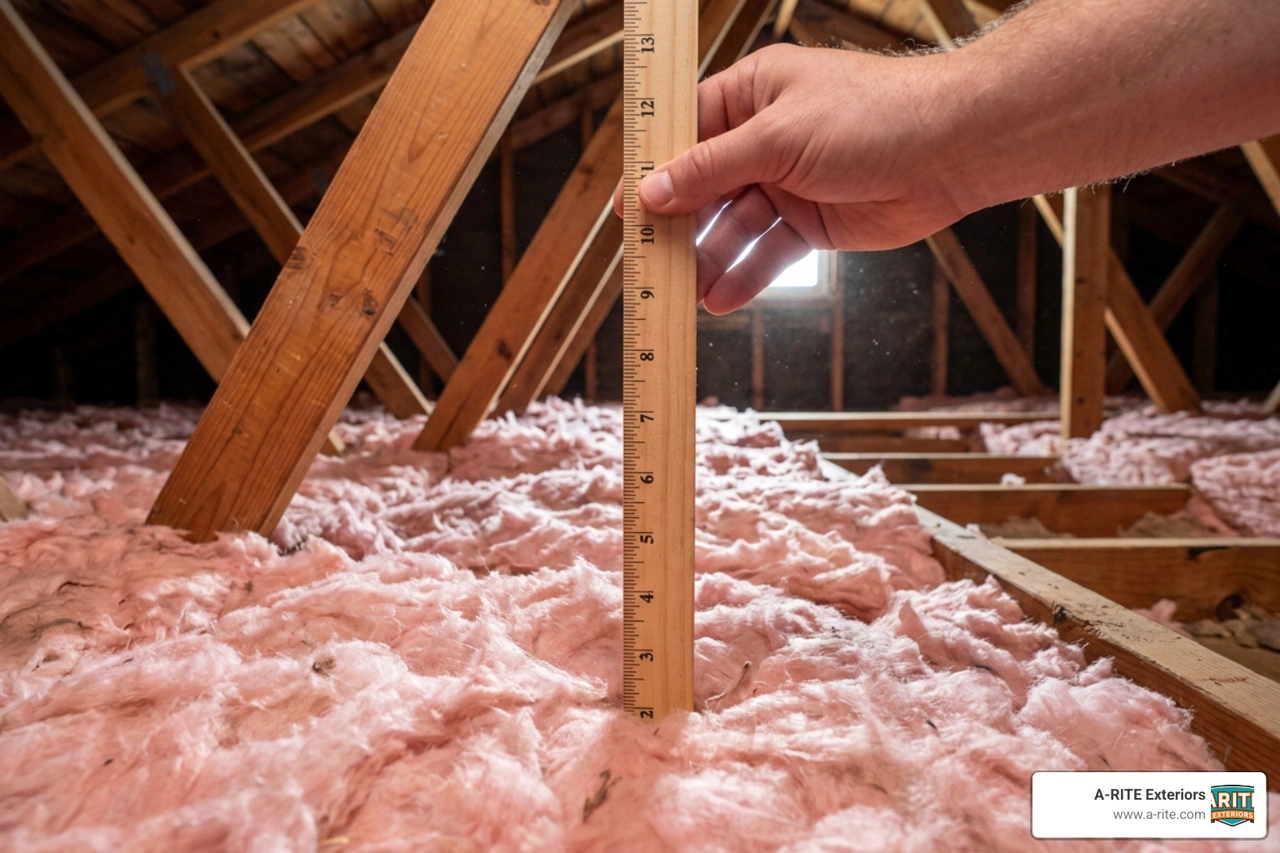
- Measure the depth: Take a ruler into your attic and measure the thickness of your current insulation in inches.
- Identify the material: Note whether you have fiberglass batts (pink or yellow blankets), blown fiberglass (white, fluffy loose-fill), or cellulose (gray, paper-like fibers).
- Do the math: Multiply the depth by the material's average R-value per inch. For example, if you have 8 inches of blown-in fiberglass (averaging R-2.5 per inch), your current attic R-value is approximately R-20. This is far below the state-mandated R-49 and the recommended R-60.
While the Wisconsin Property Assessment Manual, Volume II helps state assessors look at structural features to determine property values, an experienced contractor looks at these features to identify energy drains.
Common Pitfalls to Avoid
When upgrading your insulation, watch out for these common mistakes:
- Ignoring Air Leaks: Simply throwing new insulation over air leaks is like putting a wool sweater on over a drafty windbreaker. You must seal attic bypasses — such as gaps around chimney flues, plumbing stacks, light fixtures, and top plates — with caulk or expanding foam before laying down new insulation.
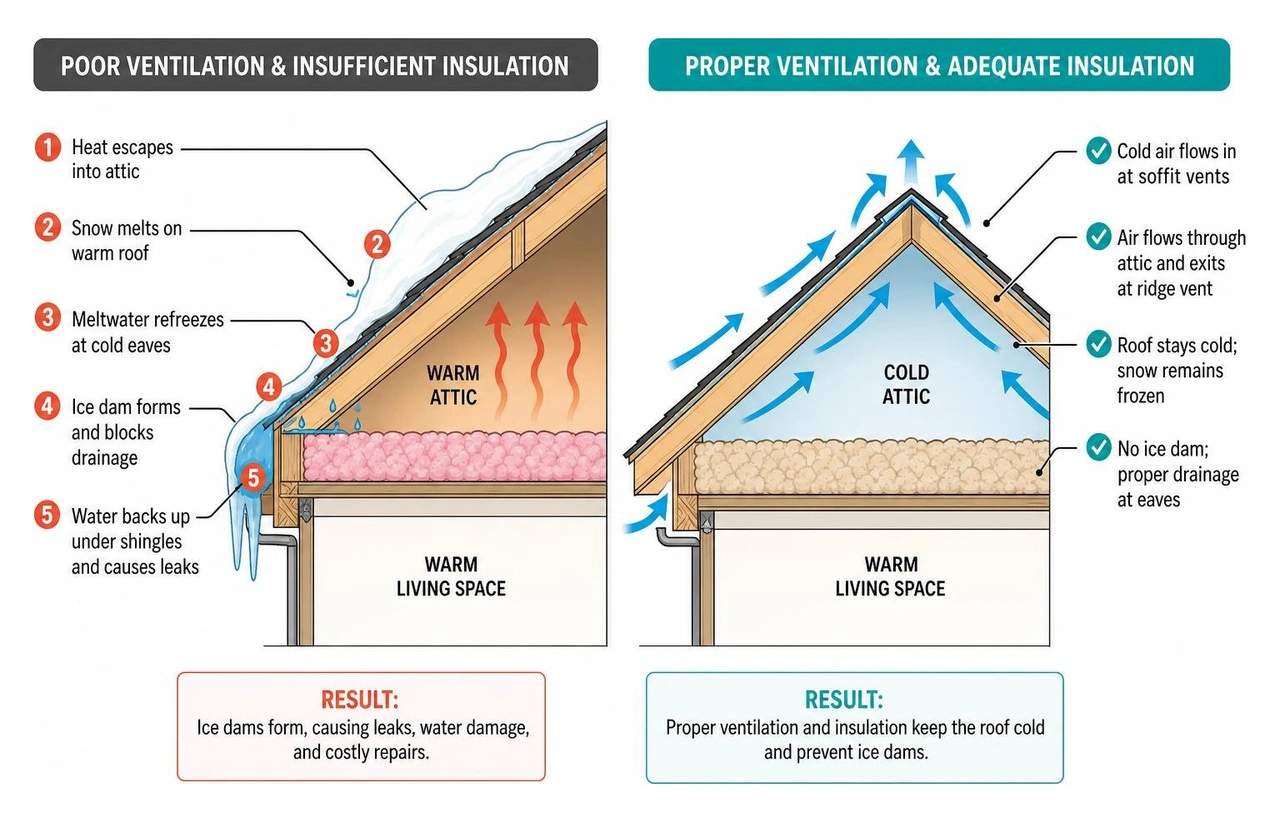
- Blocking Attic Ventilation: Your attic needs to breathe. If you blow insulation all the way to the edges of your roof and block the soffit vents, you will trap heat and moisture. This is a primary cause of mold growth and ice dams, which can destroy your shingles and gutters. Always install rafter vents (baffles) to keep the airflow path clear.
- Skipping the Vapor Barrier: In cold climates, omitting a vapor retarder on the warm side of your walls can lead to structural rot as warm, humid indoor air hits cold exterior sheathing.
Pricing, Financing, and Wisconsin Energy Rebates
Upgrading your home's insulation is a valuable investment that pays dividends in lower monthly utility bills and improved comfort. A comprehensive attic insulation and professional air-sealing project for a typical single-family home in Central Wisconsin can cost thousands of dollars, and severe cases can cost much more.
A lower price may reflect differences in materials, scope, cleanup, warranty coverage, or installation details. When planning your project, it is important to look at the complete picture of materials, professional installation, and proper ventilation.
Financing and Rebates
To help make these crucial energy upgrades more accessible, we have several options and programs available:
- A-RITE Financing: Financing options are available for qualifying homeowners. Loan amounts up to $100,000 unsecured may be available, with final approval, rates, and terms based on lender review and credit qualification.
- Focus on Energy: Homeowners may qualify for Focus on Energy rebates. These rebates are specifically designated for qualifying insulation and air-sealing work (such as attic insulation, air sealing, wall insulation, foundation insulation, duct sealing, and qualifying DIY attic insulation and air sealing), not for the roof replacement itself. Because rebate amounts and eligibility rules change over time, we always advise homeowners to confirm current program rules before starting their project.
- Federal Tax Credits (Section 25C): The Energy Efficient Home Improvement Credit has provided tax incentives for qualifying energy upgrades. Current IRS guidance shows it was available for qualifying improvements placed in service through December 31, 2025. Do not present it as an active credit for 2026 or beyond unless current IRS guidance confirms it. We always recommend consulting a tax professional to see how current federal tax laws apply to your specific home improvements.
Frequently Asked Questions about Wisconsin Insulation
What is the recommended R-value for an attic in Wisconsin?
For homes in both Climate Zone 6 and Climate Zone 7, the U.S. Department of Energy and ENERGY STAR recommend an attic R-value of R-49 to R-60. If you are retrofitting an existing attic that already has 3 to 4 inches of insulation, bringing it up to at least R-49 is the standard. If your attic is completely uninsulated, aiming for R-60 will yield the best energy performance.
Why is open-cell spray foam rarely used in Wisconsin?
Open-cell spray foam is highly permeable to moisture and has a lower density. In Wisconsin's extremely cold winters, warm indoor moisture can migrate through open-cell foam and condense against the cold roof deck, leading to mold and wood rot. Closed-cell spray foam is preferred because it acts as its own vapor barrier and boasts a much higher R-value per inch.
How does the R-value of windows compare to walls?
Windows have a much lower thermal resistance than insulated walls. While a standard 2x6 wall in Wisconsin is insulated to R-19 or R-21, even high-quality triple-pane windows typically have an R-value of around R-3 to R-5 (which corresponds to a U-factor of 0.20 to 0.30). Because windows are the thinnest part of your thermal envelope, choosing models with certified NFRC labels and low U-factors is critical to keeping drafts at bay.
Conclusion
Preparing your home for a harsh Wisconsin winter is all about securing your thermal envelope from the roof down. By focusing on the r factor for Wisconsin homes and ensuring your attic is insulated to R-49 or R-60, you can keep your furnace from running overtime and protect your roof from destructive ice dams.
At A-RITE Exteriors, we specialize in roof-first, weather-resistant solutions built specifically for Wisconsin winters and storms. Whether you are located in Wausau, Stevens Point, Minocqua, or any of our other Central Wisconsin service locations, we are here to help.
If you suspect your attic insulation is falling short, don't wait for the next big freeze. Explore our services insulation page or contact us today to partner with a trusted attic insulation contractor Central Wisconsin homeowners have relied on for over two decades. Trust the Hawk on Your Block to keep your home warm, dry, and energy-efficient all year round!