Is Your Attic Losing Heat? Here Is What R-Value You Actually Need
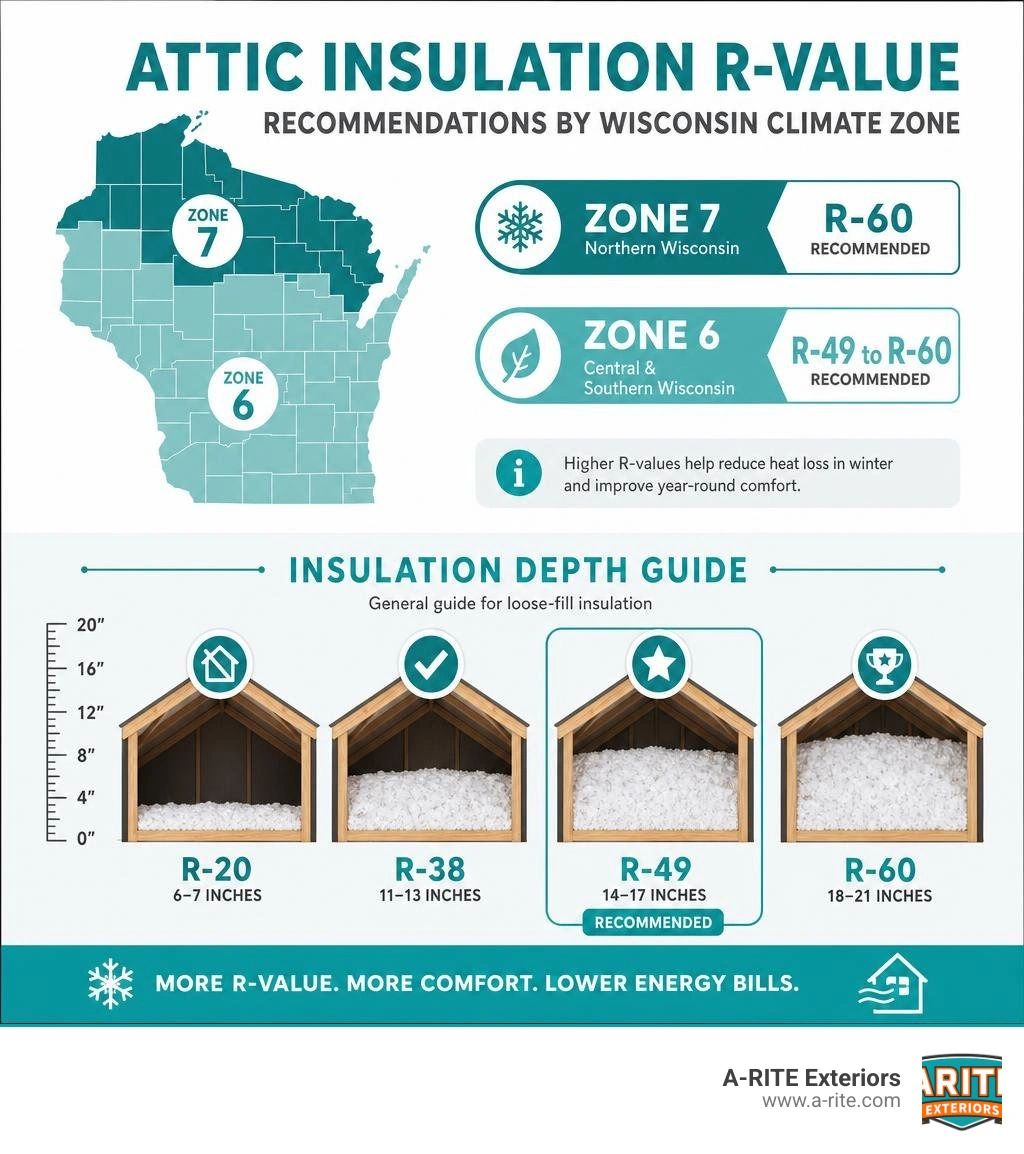
If you have been wondering what R-value insulation do I need for my attic, here is the short answer for Wisconsin homeowners:
| Your Situation | Recommended Attic R-Value |
|---|---|
| No existing insulation (Zone 6, most of Central WI) | R-49 to R-60 |
| No existing insulation (Zone 7, northern WI) | R-60 |
| Already have 3-4 inches of existing insulation | R-49 minimum, top up to R-60 |
| Already at R-38 or more | Add insulation to reach R-49 to R-60 |
These are common recommendations based on ENERGY STAR guidelines for Wisconsin climate zones. Your actual code requirement may vary, so it is always worth confirming with your local authority.
Your attic is one of the biggest sources of energy loss in your home, responsible for up to 25% of the heat that escapes during winter. Yet according to ENERGY STAR, roughly 9 out of 10 U.S. homes are under-insulated. That means most Wisconsin homeowners are paying more to heat and cool their homes than they should.
The good news is that adding attic insulation is one of the most straightforward improvements you can make. You just need to know your current insulation level, your climate zone, and your target R-value.
I'm Bryan Londerville, founder of A-RITE Exteriors, and I have been helping Central Wisconsin homeowners improve their attic performance since 2002. Helping homeowners understand what R-value insulation they need for their attic is a regular part of the work we do, especially in Wisconsin where cold winters put real pressure on under-insulated homes. In the sections below, I will walk you through everything you need to know to make a confident decision.
What is R-Value and Why Does It Matter for Your Attic?
To understand how to keep your home comfortable during a cold Wisconsin winter, you first need to understand R-value. In simple terms, R-value measures a material's thermal resistance, which is its ability to resist the flow of heat. The higher the R-value, the better the material is at stopping heat from moving through it.
Heat naturally moves from warmer spaces to cooler spaces. In the winter, the warm air produced by your furnace wants to escape into your cold attic and out through your roof. In the summer, the blazing sun heats up your roof deck, and that heat wants to push its way down into your air-conditioned living spaces.
Heat travels in three ways, and insulation plays a key role in slowing it down:
- Conduction: This is heat moving directly through solid materials. For example, heat travels from your ceiling drywall directly into your wooden ceiling joists.
- Convection: This is heat moving through air currents. Warm air rises naturally, carrying heat toward your roof.
- Radiation: This is heat traveling in electromagnetic waves. The sun radiates heat onto your roof shingles, which then radiates down into the attic space.
By installing high-quality insulation, you create a thick barrier that slows down conduction and convection. This helps keep conditioned air inside, meaning your heating and cooling systems do not have to work harder to maintain a comfortable temperature.
To learn more about how this thermal barrier protects your home, you can read our detailed guide on What R-Value Means and Why It's Important for Insulation.
What R Value Insulation Do I Need for Attic Projects in Wisconsin?
When you are planning an insulation project, your geographic location is the most important factor. The United States is divided into eight climate zones based on local weather patterns, heating degree days, and cooling needs.
Wisconsin is divided into two distinct climate zones:
- Zone 6 (Colder): This covers the majority of Central and Southern Wisconsin, including communities like Wausau, Stevens Point, Green Bay, Plover, Schofield, Weston, Mosinee, Wisconsin Rapids, Rothschild, Kronenwetter, Edgar, Marathon City, and Spencer.
- Zone 7 (Very Cold): This covers Northern Wisconsin, including places like Minocqua, Merrill, Lac du Flambeau, Arbor Vitae, WI, Tomahawk, Three Lakes, St. Germain, Woodruff, Boulder Junction, Hazelhurst, and Lake Tomahawk.
Because our winters are long and cold, the state has established clear building standards. The Wisconsin SPS 322.30 administrative code outlines thermal design standards for residential buildings. While local building codes set the legal minimum floor for new construction, energy experts and builders often recommend going further for optimal comfort.
For Wisconsin attics, a target of R-49 to R-60 is a common recommendation. If you live in the northern parts of the state (Zone 7), aiming for R-60 is highly recommended to protect your home against extreme winter temperatures. This level of insulation helps keep your heating bills manageable and ensures your indoor spaces remain cozy even when the temperature drops below zero.
Understanding Attic Insulation Materials: Why We Use Blown-In Fiberglass
There are several types of insulation materials available on the market, each with its own physical properties and R-value per inch. While some contractors use cellulose, spray foam, mineral wool, or rigid foam board, we choose to focus on blown-in fiberglass for attic projects.
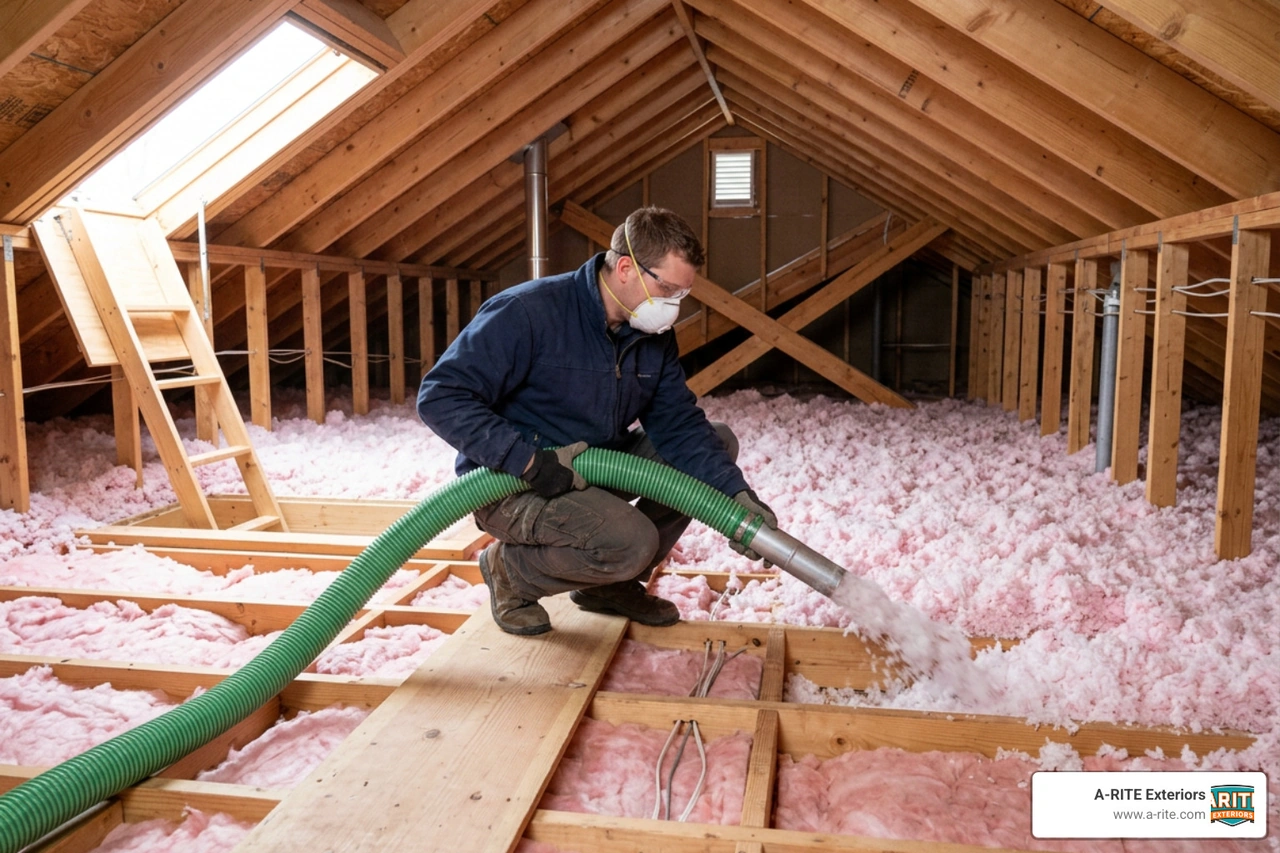
At A-RITE Exteriors, we install attic insulation using the Owens Corning AttiCat system. The AttiCat system uses loose-fill blown-in fiberglass insulation designed for attic coverage, energy efficiency, and comfort.
Let's look at how fiberglass compares to other common materials in terms of R-value per inch:
| Insulation Material | R-Value Per Inch |
|---|---|
| Blown-In Fiberglass (AttiCat) | R-2.2 to R-2.7 |
| Fiberglass Batts | R-2.9 to R-3.8 |
| Blown-In Cellulose | R-3.2 to R-3.8 |
| Mineral Wool Batts | R-3.3 to R-4.2 |
| Open-Cell Spray Foam | R-3.5 to R-3.9 |
| Closed-Cell Spray Foam | R-6.0 to R-7.0 |
While materials like spray foam offer a higher R-value per inch, blown-in fiberglass remains one of the most reliable, cost-effective, and durable choices for attic applications. It does not settle significantly over time, it is naturally naturally fire-resistant, and it does not absorb moisture the way cellulose can.
How to Determine What R Value Insulation Do I Need for Attic Upgrades
If your home was built more than a couple of decades ago, there is a very high chance it is under-insulated. As mentioned earlier, ENERGY STAR notes that 9 out of 10 U.S. homes are under-insulated. You can easily check your own attic's insulation level with a simple ruler test.
Here is how you can calculate your current attic R-value:
- Safety First: Before heading into your attic, ensure you have proper safety gear, including a dust mask, safety glasses, and gloves. Be careful to step only on the wooden joists, not on the drywall ceiling between them.
- Measure the Depth: Insert a standard ruler or tape measure vertically into your insulation until it reaches the drywall floor of your attic. Note the depth in inches. Take measurements in a few different spots, as insulation can drift and settle unevenly.
- Identify the Material: Take a look at what is currently up there. If it is pink, yellow, or white fluffy fibers, it is fiberglass. If it is gray, papery, and dense, it is cellulose.
Calculate the R-Value: Multiply your measured depth by the R-value per inch for that material. For example, if you have 6 inches of loose-fill fiberglass, your calculation would look like this:
6 inches x R-2.2 per inch = R-13.2 total current R-value.
If your current attic R-value is below R-49, your home is losing valuable heat. For more tips on identifying insulation issues, you can consult the ENERGY STAR Attic Insulation Guide.
Factors That Affect What R Value Insulation Do I Need for Attic Performance
Achieving a high R-value on paper is only half the battle. Real-world performance depends on several factors that can alter how well your insulation actually works:
- Settling Factors: Some materials, like loose-fill cellulose, can settle by 15% to 20% over the first few years, which reduces their overall depth and effective R-value. Loose-fill fiberglass is much more stable, settling by only 1% to 4%, meaning it retains its thickness and insulating power much longer.
- Moisture Control: When insulation gets wet, its R-value drops drastically because water conducts heat much faster than air. Ensuring your roof is in good condition and free of leaks is critical.
- Balanced Attic Ventilation: Your attic needs a balanced system of intake vents (usually at the soffits) and exhaust vents (at the ridge or roof peaks). This ventilation allows air to circulate, which keeps your roof deck closer to the outdoor temperature.
- Ice Dam Mitigation: During a cold Wisconsin winter, heat escaping from an under-insulated attic can melt the snow on your roof. This water runs down to the cold roof edge and freezes, forming ice dams. While proper insulation, air sealing, and balanced attic ventilation can help reduce ice dam risk, insulation alone does not stop ice dams. Additionally, ice and water shield helps protect against water intrusion if ice dams occur, but it does not prevent ice dams by itself.
Reviewing Common Air Leakage Areas and Explaining Whether Air Sealing May Be Needed
Adding thick layers of insulation is wonderful, but if air is constantly leaking from your warm living spaces directly into your attic, your insulation will not perform at its best. This convective heat loss occurs through tiny gaps and cracks in your ceiling.
Reviewing common air leakage areas and explaining whether air sealing may be needed is a crucial step before blowing in new fiberglass.
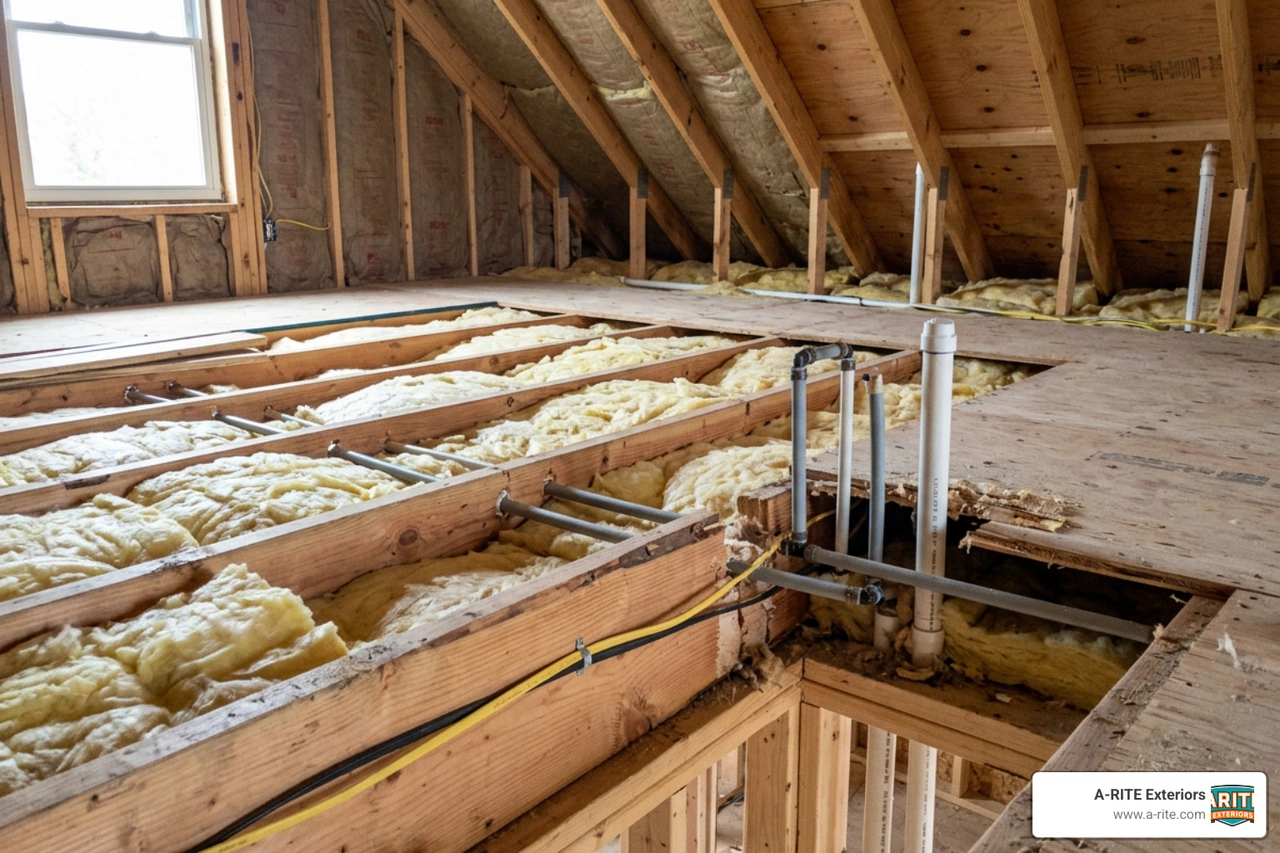
Some of the most common spots where warm air escapes into the attic include:
- Top Plates: The wooden plates at the top of your interior wall framing often have gaps where they meet the ceiling drywall.
- Plumbing and Electrical Penetrations: Holes drilled for pipes, wires, and vents are notorious for letting large amounts of warm air bypass your insulation.
- Recessed Can Lights: Standard recessed lights can act like small chimneys, drawing warm air straight out of your kitchen or living room.
- The Attic Hatch: The access door or pull-down stairs to your attic is often completely uninsulated and unsealed, leaving a major thermal gap.
- Chimney Chases: The open space around masonry chimneys is a common source of significant air leaks.
Identifying these areas is key to overall attic performance. While A-RITE Exteriors focuses on installing high-quality blown-in fiberglass insulation, we always recommend addressing these bypasses to ensure your new insulation can do its job effectively.
Frequently Asked Questions About Attic Insulation
Can I add new insulation over existing attic insulation?
Yes, you can absolutely add new insulation on top of your existing insulation, provided the old material is dry, clean, and free of mold or pests. Layering insulation is a very common way to top up your home to modern standards.
However, there are a few important rules to follow:
- Never use faced insulation on top: If you are adding fiberglass batts over existing insulation, they must be unfaced (without the paper backing). Adding a second vapor barrier in the middle of your insulation sandwich can trap moisture, leading to mold and rot.
- Check for damage first: If your existing insulation is compressed, water-damaged, or dirty, it should be evaluated.
- Safety first: If you plan to inspect or work in your attic yourself, make sure to read our Safety Tips for Homeowners Working with Insulation to protect yourself from airborne fibers and fall hazards.
How much can proper attic insulation save on energy bills?
While exact savings depend on your home's size, age, and heating system, the financial benefits of proper insulation are well-documented. The EPA estimates average savings of about 15% on heating and cooling costs from air sealing and adding insulation in attics, crawl spaces, and basement rim joists.
By keeping your heated air inside during winter and your cooled air inside during summer, you are directly helping lower your heating bills.
Additionally, Wisconsin homeowners may qualify for Focus on Energy rebates when upgrading their attic insulation. Because program rules, eligibility requirements, and rebate amounts change over time, we always advise homeowners to confirm current program rules directly with Focus on Energy before starting their project.
When should I hire a professional vs. DIY for attic insulation?
Some homeowners choose to tackle attic insulation as a weekend DIY project. While renting a blower and buying bags of insulation is possible, hiring a professional often yields much better results.
| Factor | DIY Approach | Professional Installation (A-RITE Exteriors) |
|---|---|---|
| Equipment | Standard rental blowers can be difficult to calibrate and clog easily. | We use the professional Owens Corning AttiCat system for precise, even application. |
| Coverage Quality | Hard-to-reach corners and tight eave spaces are often missed or under-insulated. | Our experienced crews ensure uniform coverage throughout the entire attic space. |
| Ventilation Protection | DIYers often accidentally cover soffit vents, blocking airflow. | We install proper ventilation baffles to ensure your attic vents remain completely clear. |
| Safety | High risk of stepping through drywall ceilings or inhaling fiberglass dust. | Trained, fully insured crews handle the entire installation safely and quickly. |
Conclusion
Determining what R-value insulation do I need for my attic is the first step toward a more comfortable, energy-efficient home. For our neighbors in Central and Northern Wisconsin, aiming for a target of R-49 to R-60 is the best way to keep your home warm, protect your roof, and lower your heating costs.
At A-RITE Exteriors, we have spent over two decades serving homeowners in Wausau, Stevens Point, Green Bay, Minocqua, and the surrounding communities. We treat your home like our own, offering roof-first, weather-resistant solutions designed to handle everything a Wisconsin winter can throw at them.
If you are ready to make your home cozier and more energy-efficient, we are here to help. Contact us today to learn more about our A-RITE Exteriors Attic Insulation Services and get a professional estimate for your home.
Trust the Hawk on Your Block!