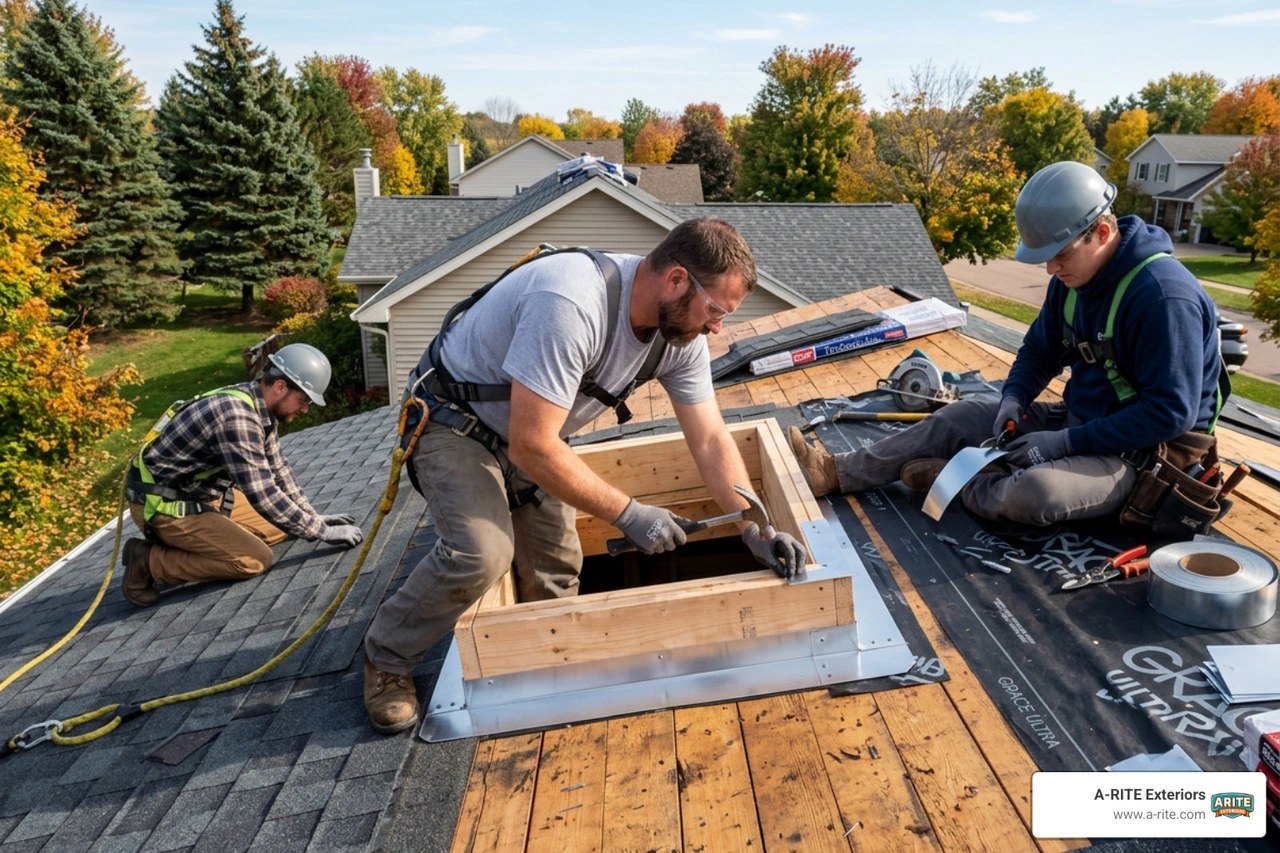
Why Is It Best to Replace Your Skylight When Replacing Your Roof?
When we evaluate a roof replacement project for a home with existing skylights, replacing the skylights at the same time is almost always the smartest structural and financial choice. The reason comes down to how roofing materials, flashing systems, and skylights work together as a single waterproof barrier.
1. Substantial Financial and Labor Cost Savings
Replacing a skylight on an existing, intact roof requires a contractor to meticulously tear up surrounding shingles, remove the old metal flashing, install the new skylight, lay down new underlayment, and weave new shingles back into the existing roof structure. That delicate labor takes significant extra time and care.
When you combine skylight replacement with a full reroofing project, the surrounding roof is already torn down to the bare wooden deck. Our crew can set the new unit, secure the framing, and wrap the opening in waterproof underlayment in a fraction of the time. On average, replacing a skylight during a full re-roof costs around $1,200 per unit, compared to $1,800 or more if completed as a standalone project down the road. That translates to roughly $600 in direct labor savings per skylight.
2. Synchronized System Lifespans
Modern asphalt architectural shingle roofing systems typically last around 20 to 30 years (though actual lifespan varies by product, installation, ventilation, maintenance, and weather exposure). High-quality glass skylights share a very similar expected lifespan of 20 to 30 years.
If your roof is 20 years old and ready for replacement, your skylight is almost certainly the exact same age. Leaving a 20-year-old skylight on a brand-new 30-year roof creates a major timing mismatch. The older unit will likely fail within 3 to 5 years, forcing you to pay premium standalone labor fees to cut into a relatively new roof. Synchronizing both components resets the clock for your entire roof line at once.
3. Preventing Vibration and Tear-Off Damage
Stripping off old shingles is aggressive work. It involves heavy tear-off spades, hammering, prying, and natural shifting of the roof decking as workers walk across the rafters.
If an old skylight has been baking under the sun for 15 or 20 years, its factory seals, butyl gaskets, and rubber glass mounts have become rigid and brittle. The vibrations and structural flexing caused by a roof tear-off frequently crack those aged seals. Even if a skylight didn't leak before the roofing project started, the physical disturbance of the tear-off process often triggers leaks weeks or months later.
4. Flashing Integration and Water Barriers
A skylight is a large hole cut directly into your roof deck. Its ability to shed rain, sleet, and melting snow depends almost entirely on the surrounding flashing kit and underlayment membrane.
During a full roof tear-off, we apply self-adhered rubberized ice and water shield underlayment directly to the wooden deck around the entire skylight curb, extending several inches up the frame. We then weave new metal step-flashing pieces course-by-course between fresh shingles. Attempting to retrofit flashing around an old skylight on an existing roof never produces the same clean, continuous seal.
When planning your project, it's also worth learning Why You Should Not Roof Over Existing Shingles, as overlaying shingles severely limits your ability to inspect or replace skylight flashing properly. For a deeper technical look at installation methods, you can review this Skylight Replacement E-Book Guide.
| Project Consideration | Bundled with Roof Replacement | Standalone Replacement Later |
|---|---|---|
| Estimated Cost Per Unit | ~$1,200 | ~$1,800 or more |
| Labor Efficiency | High (deck already exposed) | Low (requires partial roof tear-up) |
| Flashing Integration | Seamless multi-layer waterproof seal | Retrofitted around existing shingles |
| Roof Deck Protection | Complete ice & water shield wrapper | Limited to perimeter repair area |
| Risk of Future Roof Leaks | Extremely low | Moderate to high |
| Warranty Synchronization | Fully aligned with new roof warranty | Separate coverage; potential roof waiver |
What Are the Signs That Your Skylight Needs to Be Replaced?
Homeowners often ask us if their skylights are candidate units for replacement or if they can safely remain in place. While a visual inspection from a ladder or roof deck is best, several clear signs indicate a skylight is reaching the end of its useful life.
Key Inspection Indicators
- Age Exceeding 10 to 15 Years: Standard builders-grade skylights commonly begin experiencing seal degradation after 10 to 15 years of atmospheric exposure. Higher-end insulated glass units often last 20 to 30 years, but any unit past its 15th birthday should be thoroughly evaluated during reroofing.
- Fogging or Condensation Between Panes: Insulated double-pane glass skylights use gas fills (such as argon) sealed between glass layers. If you notice persistent fog, moisture drops, or a hazy film between the glass panes that you can't wipe clean from inside or outside, the thermal seal has failed.
- Yellowing, Cracking, or Clouding on Acrylic Domes: Older homes across Central Wisconsin frequently feature bubble-style acrylic or plastic dome skylights. Over time, harsh ultraviolet (UV) radiation breaks down plastic polymers, turning them yellow, brittle, and hazy. Hairline cracks in acrylic can rupture under heavy winter snowpack.
- Ceiling Water Stains or Frame Discoloration: Inspect the interior drywall shaft surrounding your skylight inside your home. Water lines, dark brown ring stains, bubbling drywall tape, or peeling ceiling paint indicate water is penetrating the flashing or condensation is pooling inside the framing cavity.
- Drafts and Seasonal Heat Loss: If you feel a noticeable cold draft standing under your skylight in January or experience excessive solar heat buildup in July, the insulated frame or weatherstripping has likely broken down, creating a thermal bridge straight into your home.
Wisconsin Climate Stress Factors
Living in Central Wisconsin, whether in Wausau, Stevens Point, Marshfield, or the Northwoods, exposes roof penetrations to extreme thermal cycling. Winter temperatures frequently drop well below zero, followed by heavy snow accumulation.
When heat escapes through an older, poorly insulated skylight, it melts the underside of the snowpack resting on the glass. That melted water flows down to the cold roof perimeter around the flashing, where it refreezes into ice dams. This freeze-thaw stress expands metal flashing seams and forces water under old shingles. Choosing What Is the Best Roofing System for Wisconsin Weather helps protect your home from winter ice damming, and replacing outdated skylights eliminates a primary source of escaping attic heat.
How Do Deck-Mounted and Curb-Mounted Skylights Differ During Replacement?
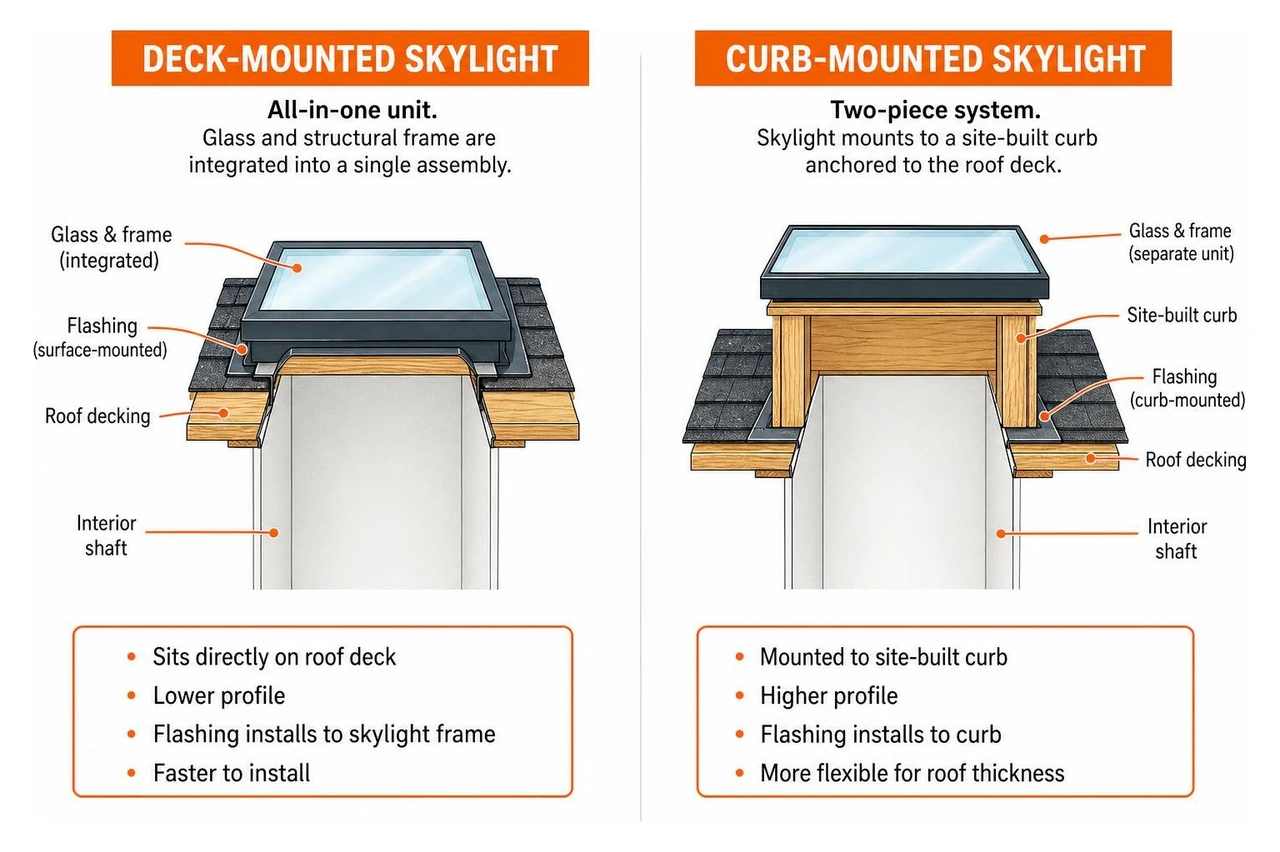
Before ordering a replacement unit, your contractor needs to determine whether your existing skylight is deck-mounted or curb-mounted. These two structural designs operate differently and require distinct installation steps during a roof replacement.
Deck-Mounted Skylights
A deck-mounted skylight is an all-in-one manufactured unit where the glass and structural wood frame are integrated into a single assembly.
- Installation: The unit fastens directly to the plywood roof decking over the rough opening.
- Profile: It has an attractive, low-profile appearance that sits flush with the roofline.
- Flashing System: Uses engineered step-flashing kits that slide under the unit's factory-installed rubber skirt and interweave directly into the shingle courses.
- Best Suited For: Roof pitches of 3:12 or steeper. They are the most common choice for modern residential shingle roof replacements.
Curb-Mounted Skylights
A curb-mounted skylight relies on a wooden box frame (typically constructed from 2x4 or 2x6 lumber) built directly onto the roof deck around the ceiling opening. The wooden curb stands roughly 4 to 6 inches above the roof plane.
- Installation: The roofers wrap the wooden curb in ice and water shield and apply custom apron and step flashing to the sides of the wood frame. The skylight unit then caps over the top of the wooden box like a lid on a shoe box.
- Profile: Sits higher off the roof plane, making it visually distinct.
- Best Suited For: Low-pitch roofs (below 3:12) or as a quick replacement for older acrylic bubble units where the existing wooden curb is still structurally sound.
During a roof tear-off, we inspect the existing wooden curb on curb-mounted units. If the wood exhibits rot, water saturations, or out-of-square warping, we rebuild the wooden curb using pressure-treated lumber before setting the new skylight. Deck-mounted and curb-mounted units are not directly interchangeable without modifying the underlying structural roof opening.
Modern Upgrade Options
When replacing your unit, you can choose from several distinct functional styles depending on your daylighting and ventilation goals:
- Fixed Skylights: Sealed glass units designed purely to bring natural daylight into living spaces. They do not open.
- Manual Venting Skylights: Feature a hand crank or extension pole hook that allows the window to pop open, releasing hot indoor air and moisture.
- Solar-Powered Venting Skylights: Equipped with a small solar panel that powers an electric motor to open and close the skylight via remote control. Most include built-in acoustic rain sensors that automatically close the unit at the first drop of precipitation.
- Tubular Daylighting Systems: Compact reflective tubes (often called Sun Tunnels) that channel daylight from small roof domes down into hallways, closets, or interior bathrooms.
Explore our full breakdown in A Quick Guide to Different Types of Skylights to select the right feature set for your space.
Will Keeping an Old Skylight Affect Your New Roof's Warranty?
Protecting your investment in a new roof requires understanding the difference between your manufacturer material warranty and your contractor workmanship warranty. Keeping an old skylight on a new roof can complicate both.
Workmanship Warranty Exclusions
Reputable roofing contractors provide a comprehensive workmanship warranty covering installation labor and leak protection across the entire roof plane. However, if a homeowner insists on keeping a 15- or 20-year-old skylight during a full re-roof, contractors will often exclude the roof area surrounding the old skylight from workmanship coverage.
Because tear-off vibrations and prying up old flashing can compromise brittle gaskets, contractors cannot guarantee that a 20-year-old skylight won't leak within months. Some contractors require homeowners to sign a formal liability waiver acknowledging that leak repairs around the reused unit will be billed as extra service calls.
Manufacturer Coverage Risks
Major roofing manufacturers (such as GAF or Owens Corning) offer robust material warranties when a complete, integrated roofing system is installed according to strict factory specifications. This includes installing approved underlayment and seamless flashing around all roof penetrations.
If an old, reused skylight fails and allows water to seep underneath nearby new shingles, the shingle manufacturer may deny warranty claims for wood deck rot or shingle deterioration in that section of the roof, citing improper penetration flashing or maintenance neglect.
The Shingle Batch Color Mismatch Problem
If you decide to keep an old skylight and it begins leaking 3 years after your new roof is installed, fixing it requires retrofitting a new unit. To install proper flashing, the roofing crew must tear off 3 to 4 feet of surrounding shingles around the entire unit.
Because asphalt shingles are manufactured in distinct production runs or "dye lots," new shingles installed 3 years later rarely match the exact color shade of the surrounding, weather-exposed roof. You end up paying significantly more in labor fees and are left with a visible patch on your roof line. For more insight on how roofing contractors approach skylight retrofits, read Is a replacement skylight job handled by a roofing contractor?
Who Should Handle Your Skylight Replacement During a Reroofing Project?
While standalone window specialists or glass repair shops can replace skylights, a licensed Roofing contractor is the ideal professional to execute a skylight replacement during a reroofing project.
Skylight replacement on an active roof is primarily a roofing and weatherproofing task, not an interior window job. The crucial work happens on the exterior roof deck, where shingles, underlayments, and step flashing interlock.
The 3-Layer Leak Protection System
When our crew installs a replacement skylight during a roof replacement, we apply a proven three-layer waterproofing strategy around the frame:
- Layer 1: Continuous Deck Seal Gasket: A heavy-duty foam or rubber gasket seals the base of the skylight frame tight against the wooden deck or top of the wooden curb, preventing wind-driven rain from blowing underneath the frame.
- Layer 2: Self-Adhesives Membrane Wrapper: We wrap the entire perimeter of the opening with a thick, self-adhering rubberized ice and water shield underlayment. This membrane adheres tightly to both the wood roof deck and the vertical sides of the skylight frame, creating a seamless waterproof membrane.
- Layer 3: Engineered Step Flashing: Individual L-shaped metal step-flashing pieces are installed sequentially with every single course of new asphalt shingles from the bottom of the skylight up to the top. Water shedding down the roof hits the flashing and is funneled safely back onto the surface of the shingles.
Integrating Roof Ventilation and Attic Insulation
Skylight light shafts pass directly through your unconditioned attic space. If your attic lacks proper thermal insulation or balanced roof ventilation, warm moist air from inside your home rises into the light shaft. In winter, this warm air hits the cold skylight frame, creating condensation that drips down interior walls, mimicking a roof leak.
When updating your roof, evaluate overall attic performance. We provide professional attic insulation services to ensure heat stays inside your living space while your roof deck remains cold.
Homeowners may qualify for Focus on Energy rebates for qualifying insulation and air-sealing work (such as attic insulation, air sealing, wall insulation, foundation insulation, duct sealing, and qualifying DIY attic insulation and air sealing), though these rebates do not apply to roof replacement itself. Rebate amounts and eligibility rules change over time, and homeowners should confirm current program rules before starting work. Approved neutral sources for verifying energy standards include Focus on Energy, Focus on Energy, Wisconsin DSPS, EPA, and ENERGY STAR.
Regarding federal tax incentives, IRS guidance showed that the Section 25C Energy Efficient Home Improvement Credit was available through December 31, 2025; do not present it as active for 2026 or beyond unless confirmed by current IRS guidance. Always consult a tax professional when evaluating tax credits. Neutral sources for tax and energy guidance include the IRS, ENERGY STAR, and the BBB.
If you are exploring broader exterior updates alongside your roof project, consult our comprehensive guide on Who Can Help with Roofing, Gutters, Siding, Windows, and Insulation Near Me.
Financing options are available for qualifying homeowners. Loan amounts up to $100,000 unsecured may be available, with final approval, rates, and terms based on lender review and credit qualification.
What Are Frequently Asked Questions About Skylight and Roof Replacement?
Should I replace my skylight if it isn't currently leaking?
Yes, if the skylight is 10 to 15 years old or older, you should strongly consider replacing it during your roof replacement even if it shows no visible drips today.
Skylight seals age gradually under UV rays and winter freeze-thaw cycles. The heavy vibrations, hammering, and structural flexing involved in tearing off old shingles commonly break aging butyl gaskets and sealants. Replacing a non-leaking, 15-year-old unit while the roof deck is already exposed costs roughly $1,200, whereas waiting for it to leak 2 years later will likely cost $1,800 or more in standalone labor and material costs.
Can I replace a skylight myself, or should I hire a professional contractor?
We strongly advise against DIY skylight installation. Installing a skylight requires working on steep roof pitches and integrating specialized metal step flashing and self-adhering membranes directly into shingle courses.
An error in flashing sequencing or underlayment wrapping allows water to seep directly into your roof deck framing and ceiling cavities. Unseen water intrusion behind drywall can cause severe wood rot and structural frame damage that can cost thousands of dollars, and severe cases can cost much more. Hiring a licensed roofing professional ensures proper leak guarantees and preserves shingle manufacturer warranties.
How long does it take to replace a skylight during a roof replacement?
When completed alongside a full reroofing project, replacing a standard deck-mounted or curb-mounted skylight takes our crew approximately 1 to 3 hours per unit.
Because the old shingles and underlayments are already stripped away down to the bare decking, our installers can unbolt the old frame, inspect the curb, lay down new ice and water shield, mount the new skylight, and interweave step flashing quickly without interrupting the flow of the overall roofing project. Replacing a standard unit involves exterior work only, resulting in minimal to zero disruption inside your home.
What Is the Best Next Step for Your Skylight and Roof Replacement?
Deciding whether to replace your skylight alongside your roof comes down to four clear factors: unit age, labor savings, long-term leak prevention, and warranty protection. If your skylight is over 10 years old, replacing it during reroofing saves approximately $600 in labor costs, prevents tear-off vibration damage, and ensures your new roof and daylighting system share the same 20- to 30-year lifespan.
When budgeting for your project, keep in mind that total roof replacement costs across Central Wisconsin commonly range from upper four figures to mid five figures, with final pricing depending on factors such as roof size, pitch, layers, decking condition, selected shingle materials, and labor scope. When reviewing contractor proposals, a lower price may reflect differences in materials, scope, cleanup, warranty coverage, or installation details.
If your home in Wausau, Stevens Point, Schofield, Weston, or surrounding areas is due for a new roof, have your skylights professionally evaluated before tear-off begins. For localized service details and inspection options, visit our dedicated guide on Roof Replacement Stevens Point WI. Contact our team at A-RITE Exteriors today to schedule an expert, honest roof deck and skylight assessment built for Wisconsin weather.