Do You Automatically Need New Gutters When Replacing Your Roof?
No rule in residential construction states that a new roof requires new gutters by default. If your current gutter troughs are structurally sound, pitched accurately, firmly anchored, and properly sized for your roofline, they can remain in place while a new roof is installed above them.
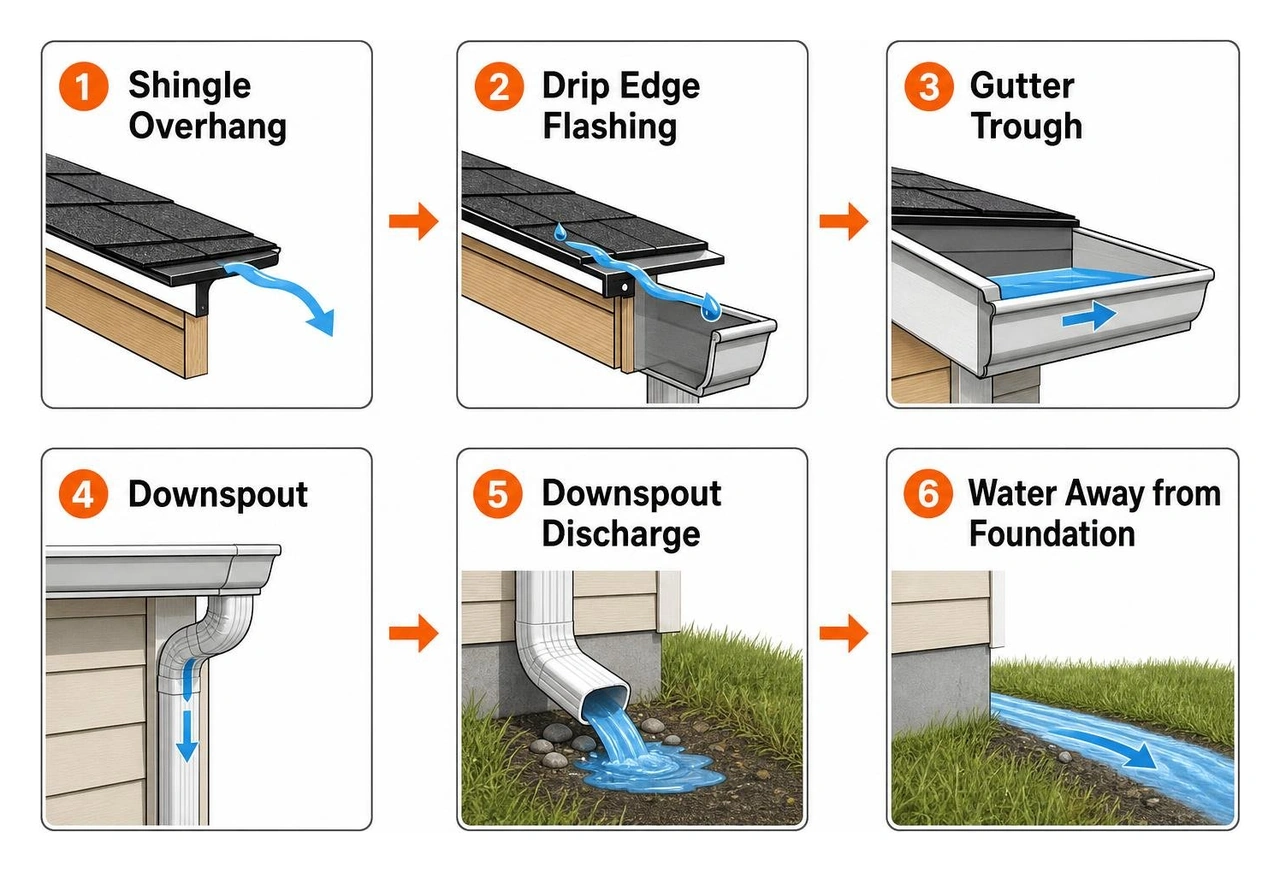
However, treating the roof and gutters as separate, unrelated components overlooks how residential water management functions. Your roof and gutter system operate as a single, unified drainage barrier. When rain falls or heavy snow melts across your roof plane, water travels across shingles, across the drip edge flashing, into the gutter troughs, down the downspouts, and away from your foundation. If any segment in that water path fails, the integrity of the entire exterior boundary is compromised.
When we evaluate a roof replacement across Central Wisconsin homes, from Wausau and Stevens Point to Minocqua and Wisconsin Rapids, we systematically inspect the drainage system to determine whether keeping or replacing your gutters makes the most technical and financial sense. We base this evaluation on four key criteria:
- Age and Expected Service Life: Most residential aluminum gutters have a typical lifespan of 20 to 25 years. Standard asphalt shingle roofs commonly last 20 to 30 years, though exact longevity varies by product, installation, ventilation, maintenance, and weather exposure. If your gutters were installed at the same time as your old roof, they are likely near the end of their reliable service life.
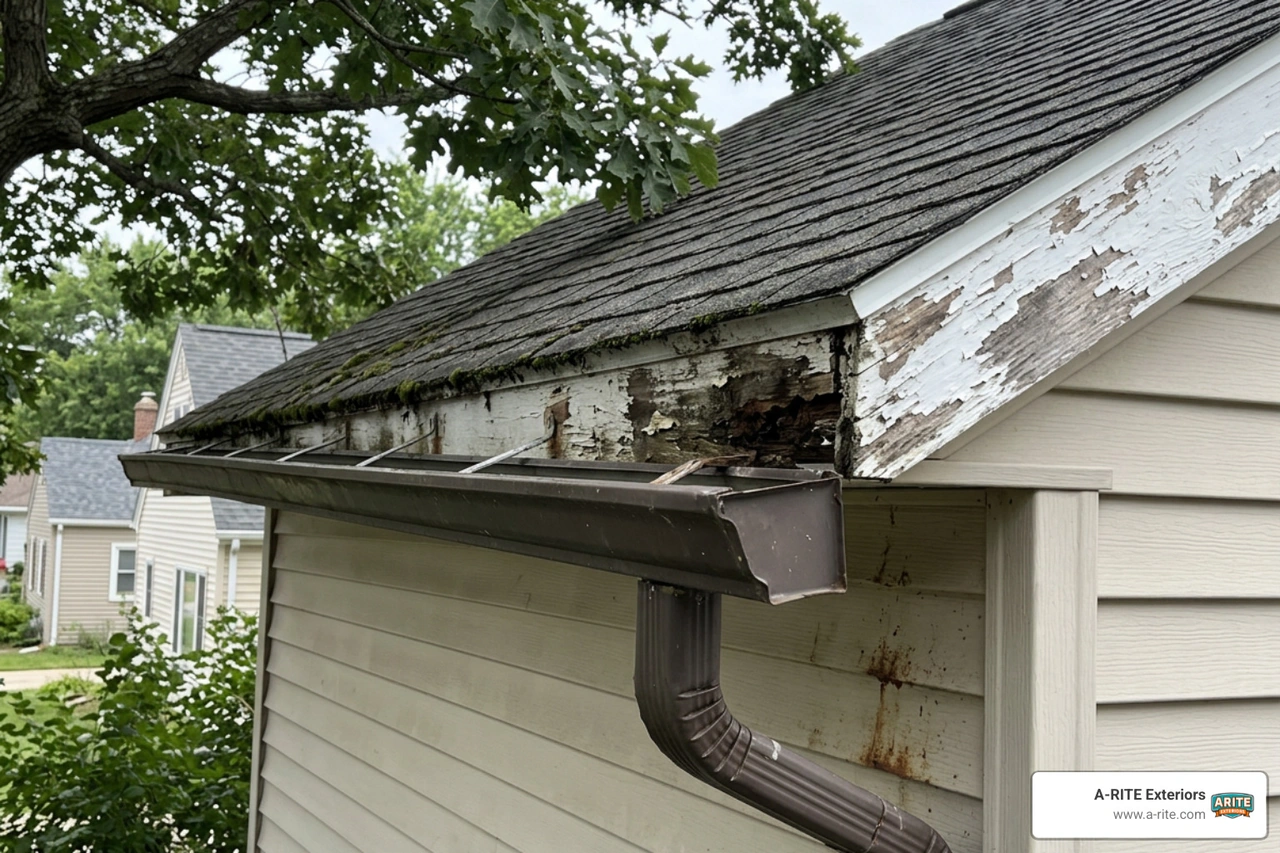
- Physical and Structural Integrity: We inspect for cracks, sagging troughs, separated miters, rust spots, loose hidden hangers, and peeling exterior finishes.
- Capacity and Local Weather Demands: Many older homes were fitted with standard 5-inch sectional gutters. In northern and central regions that experience intense summer thunderstorms and heavy spring snowmelt, these smaller systems frequently overflow.
- Roof-Edge Integration: Installing a modern roofing system requires adding new drip edge flashing along eaves and rakes. If your existing gutters are warped, bent, or hung too high or low, integrating them with new perimeter flashing without creating water gaps can be difficult or impossible.
When Can You Keep Your Existing Gutters During a Roof Replacement?
You can confidently keep your current gutter system if it meets clear performance and physical condition benchmarks:
- Age Under 10 to 15 Years: Seamless aluminum gutters in this age bracket that have been maintained regularly often have more than a decade of reliable service remaining.
- Seamless Construction: Unlike older sectional gutters that have caulked joints every 10 feet, seamless gutters have unbroken runs along each eave, drastically reducing the risk of hidden leaks.
- Firm Attachment and Sound Fascia: Troughs should be secured tightly with heavy-duty hidden screw hangers spaced every 24 inches (or every 18 to 24 inches in heavy snow regions), with no signs of soft, rotting fascia wood behind them.
- Accurate Drainage Slope: Water must flow cleanly toward each downspout at a continuous slope of approximately 1/4 inch per 10 feet of horizontal run, leaving no standing water or sediment in the bottom of the channel.
- Sufficient Sizing: The gutters must handle the square footage and pitch of your roof without overflowing during normal rain events.
When existing gutters meet these standards, our crews protect them throughout the roofing project. During the tear-off phase, old shingles, nails, and underlayment must come off the roof. To protect your gutters, we use ladder stand-offs and stabilizers so ladders never bear weight against the outer gutter lip. We also run reinforced protective tarps over the gutters to catch falling debris and prevent dents.
Reviewing a comprehensive roof replacement home preparation guide helps homeowners understand how our teams secure both the landscape and exterior fixtures before work begins. Once the roof installation is complete, any minor gutter pitch adjustments or loose hangers can be corrected without the expense of a full replacement.
Warning Signs Your Gutters Must Be Replaced
If your gutters exhibit any of the following warning signs, keeping them during a roof replacement often leads to premature failures, exterior water intrusion, and repeated contractor visits.
- Hidden Fascia Rot Behind the Troughs: When gutters pull loose, water slips behind the channel and soaks the underlying wood. If the fascia board feels spongy or shows signs of wood rot, the gutters must come down so the damaged wood can be repaired or replaced before new metal is hung.
- Cracked Seams and Leaking Miters: Sectional gutters rely on caulked joints that dry out, expand, and crack under freezing winter temperatures. If your gutters drip at the seams or corners, the sealant has failed.
- Rust Streaks, Oxidation, and Peeling Paint: Visible rust on steel gutters or heavy chalking and peeling on older aluminum indicates structural degradation of the metal.
- Sagging Channels and Standing Water: Troughs that dip in the middle retain standing water, creating heavy stress points that pull fasteners loose from the rafters.
- Repeated Overflow During Normal Storms: If water regularly sheets over the gutter edge during average rainfall, the system is either undersized or lacks sufficient downspout capacity.
- Mismatched Lifespans: Leaving 20-year-old gutters on a brand-new 30-year roof means you will likely need a messy gutter tear-off in just a few short years, risking accidental impact to your fresh drip edge and shingles.
Following established industry standards for removing gutters during roof replacement allows contractors to thoroughly inspect perimeter roof decking, ice-and-water barriers, and fascia boards that remain hidden when gutters are left in place.
What Are the Financial and Practical Benefits of Bundling Roof and Gutter Replacement?
Scheduling gutter replacement at the same time as your roof installation provides significant financial and logistical advantages. The primary driver of these savings is labor efficiency.
When you contract a standalone gutter replacement, the company must charge for dedicated site visits, fuel, equipment setup, disposal fees, and specialized crew labor. When bundled with a roof replacement, those staging and setup costs are shared across the broader project.
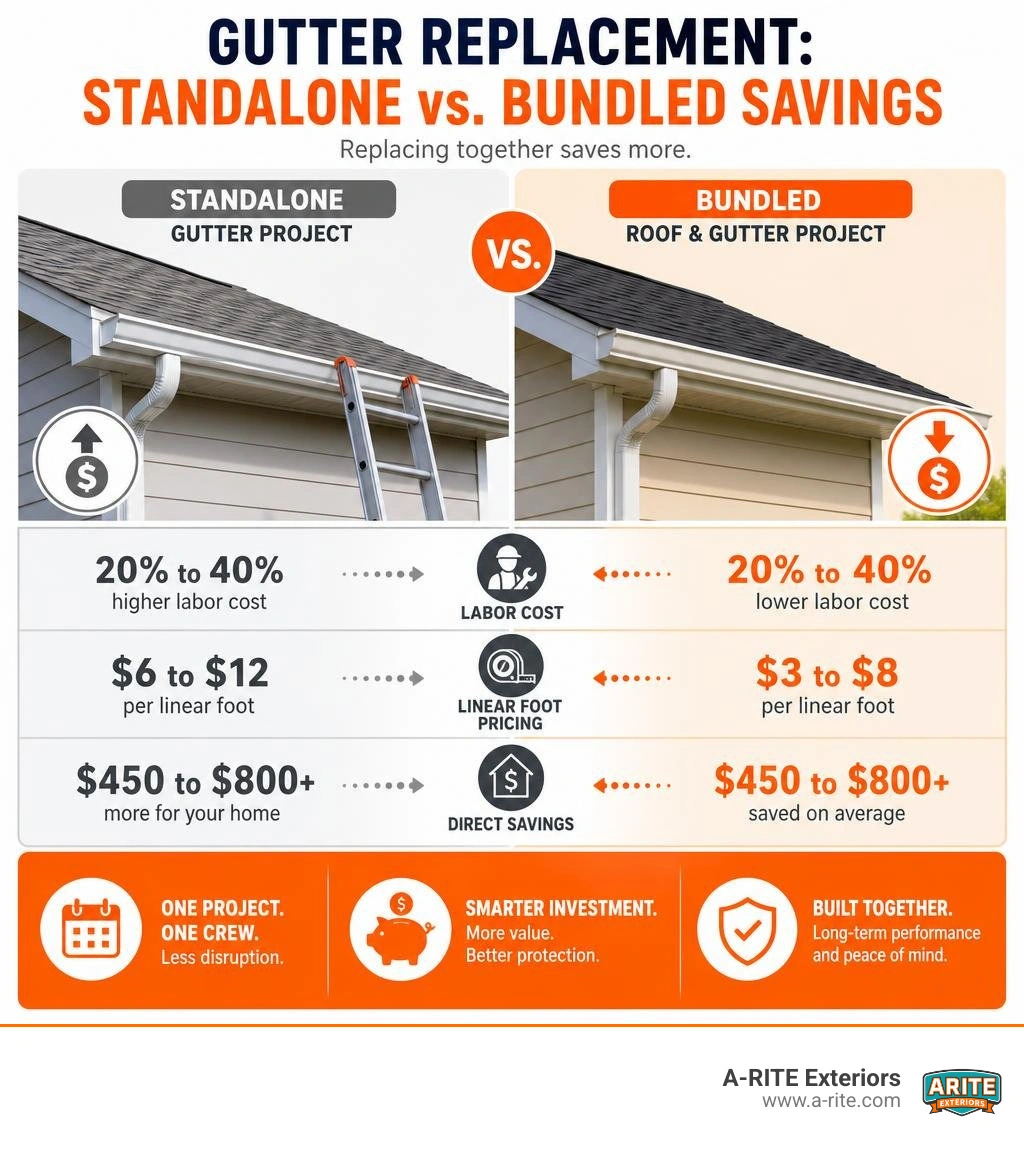
- Labor Cost Reductions: Bundling gutter installation with a roof replacement commonly reduces gutter labor costs by 20% to 40%.
- Linear Foot Pricing: Gutters installed alongside a roof replacement typically run $3 to $8 per linear foot, compared to $6 to $12 per linear foot when contracted as a separate, standalone project.
- Direct Household Savings: For a typical single-family home requiring 150 to 200 linear feet of gutters, bundling the project results in direct savings of $450 to $800 or more.
| Factor | Standalone Gutter Project | Bundled Roof & Gutter Project | Homeowner Benefit |
|---|---|---|---|
| Gutter Cost per Linear Foot | $6 – $12 / linear foot | $3 – $8 / linear foot | Saves $3 – $4 per foot on materials/labor |
| Average 175 ft. Installation | $1,050 – $2,100 | $525 – $1,400 | Direct savings of $450 to $800+ |
| Staging & Disposal Fees | Billed separately | Shared with roofing dumpsters | Zero redundant delivery or debris charges |
| Fascia Board Access | Difficult; extra labor fees | Full access during tear-off | Easy inspection and direct wood repair |
| Warranty & Workmanship | Two separate warranties | Single unified contractor warranty | Single point of accountability |
A full roof replacement investment typically falls in the upper four figures to mid five figures, with the final price depending on roof size, pitch, layers, decking, materials, and labor. When reviewing estimates, a lower price may reflect differences in materials, scope, cleanup, warranty coverage, or installation details.
For property owners planning extensive exterior upgrades, flexible payment solutions help balance project scope and budget. Financing options are available for qualifying homeowners. Loan amounts up to $100,000 unsecured may be available, with final approval, rates, and terms based on lender review and credit qualification.
Having a single exterior contractor handle both the roof and gutters eliminates the common finger-pointing that occurs between separate trades if an edge leak develops. When one certified crew manages the entire water-shedding assembly, your warranty covers the complete perimeter interface under one point of contact.
Adding Gutter Guards During Roof Replacement
If you are replacing gutters during your roof project, installing premium gutter guards at the same time delivers an exceptional return on investment.
Adding gutter guards concurrently reduces guard installation labor by 30% to 50% because crews are already working at the roofline with ladders and scaffolding in position.
Gutter guards provide immediate practical value by keeping gutters free of pine needles, leaves, and maple seeds:
- Eliminating Cleaning Expenses: Routine professional gutter cleaning commonly costs $150 to $350 per visit, with most wooded Wisconsin properties requiring two to three cleanings annually.
- Long-Term Savings: Quality micro-mesh guards can save homeowners $250 to $900 annually in cleaning fees, resulting in $5,000 to $27,000 in saved maintenance costs over the 20- to 30-year lifespan of the gutter system.
- Winter Protection: By keeping channels clear of decaying organic sludge, guards allow water to drain freely during winter freeze-thaw cycles, reducing the moisture reservoir that feeds heavy ice buildup along eaves.
- Warranty-Safe Mounting: Modern micro-mesh systems fasten securely to the gutter lip and fascia without lifting shingles, penetrating roof underlayment, or risking the manufacturer's shingle warranty.
How Do Drip Edges, Gutter Sizing, and Proper Sequence Prevent Water Damage?
A gutter cannot protect your home if it is poorly integrated with the edge metal of the roof. To understand why, you must trace the precise water path from roof deck to ground:
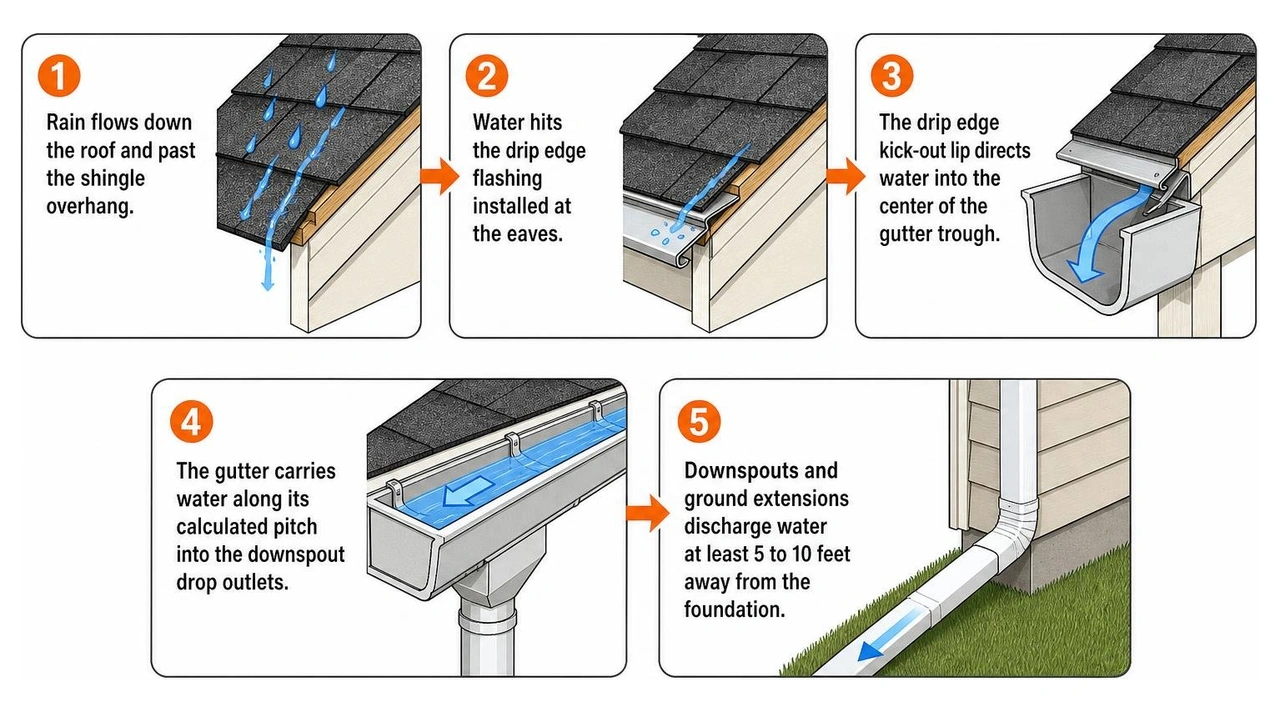
- Rain sheets down the roof surface and flows past the shingle overhang (typically 3/8 to 3/4 inch beyond the drip edge).
- Water hits the metal drip edge flashing, which is installed along the deck edge over the underlayment at the eaves.
- The lower kick-out lip of the drip edge directs the water away from the fascia board and channels it directly into the center of the gutter trough.
- The gutter carries water along its calculated pitch into the downspout drop outlets.
- Downspouts and ground extensions discharge the volume at least 5 to 10 feet away from foundation walls.
Understanding how gutters help prevent water damage highlights the danger of gaps in this chain. If old gutters are left in place during a reroof, the new drip edge flashing installed by the roofing crew might not align with the old gutter placement. When drip edge metal does not extend cleanly over the rear gutter wall, surface tension causes water to curl backward, running directly down the fascia board behind the gutter.
Unchecked moisture behind the gutter rots the fascia, degrades soffits, soaks exterior siding, and seeps into basement walls. Repairing structural foundation damage, rotted rafter tails, and mold remediation can cost thousands of dollars, and severe cases can cost much more.
To prevent these integration errors, proper installation follows a strict sequence:
- Step 1: Complete Roof Tear-Off: Old shingles and underlayment are removed down to the bare wooden roof deck.
- Step 2: Decking and Fascia Inspection: Crews inspect the exposed perimeter deck boards and fascia wood, replacing any rotted or weakened lumber.
- Step 3: Underlayment and Drip Edge Installation: Self-adhering ice-and-water shield is applied along the eaves, followed by heavy-gauge corrosion-resistant drip edge flashing.
- Step 4: Shingle Application: Starter strips and field shingles are nailed down with proper overhang dimensions.
- Step 5: Seamless Gutter Fabrication and Hanging: Custom seamless gutters are rolled on-site to exact eave lengths and tucked precisely under the drip edge lip, pitched accurately toward downspout drops, and fastened securely with heavy-duty internal screw hangers.
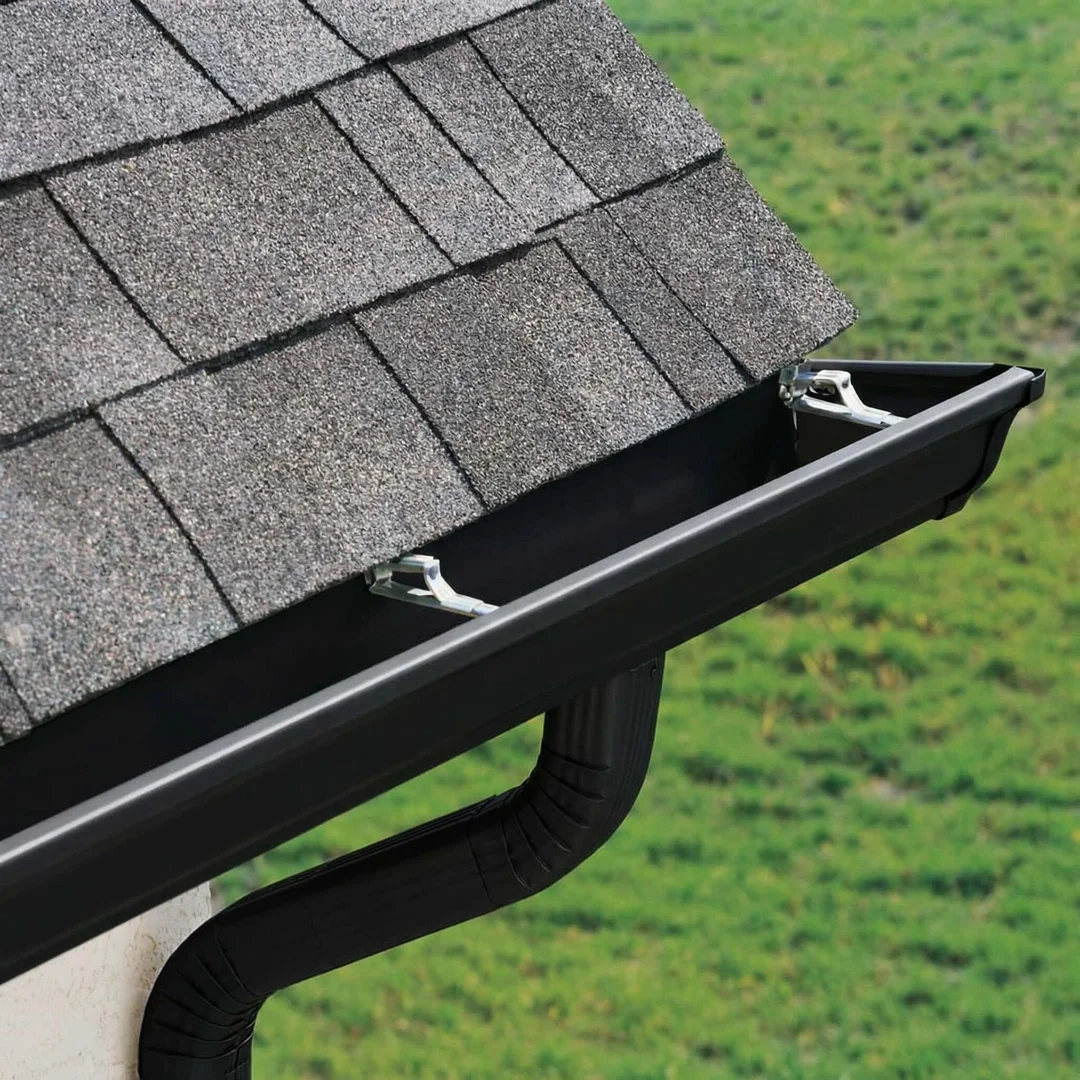
Upgrading from 5-Inch to 6-Inch Gutters for Severe Weather
When replacing your gutters, choosing the appropriate channel and downspout capacity is critical for long-term performance. Residential gutters traditionally came in 5-inch standard widths, but 6-inch seamless systems have rapidly become the standard for modern homes.
- 5-Inch Gutters: Hold approximately 1.2 gallons of water per linear foot.
- 6-Inch Gutters: Hold approximately 2.0 gallons of water per linear foot, which is an increase of roughly 40% in total drainage volume.
In Central and Northern Wisconsin, where winter produces substantial snow accumulation and summer brings severe thunderstorms, 6-inch gutters offer crucial protection. A larger channel provides several distinct benefits:
- Handling Steep Roof Pitches: Steeply pitched roofs (such as 8/12 or 10/12 slopes) accelerate the speed of water runoff. A 5-inch gutter can easily be overshot by fast-moving rainwater, while a 6-inch trough provides a wider opening to catch high-velocity sheeting.
- Managing Complex Rooflines: Valleys where two large roof planes converge dump enormous concentrated volumes of water into a single section of gutter.
- Matching with Oversized Downspouts: A 6-inch gutter pairs with large 3x4-inch downspouts rather than restrictive 2x3-inch downspouts. A 3x4-inch downspout carries more than double the water volume of a 2x3-inch pipe, virtually eliminating drainage choke points and reducing debris clogs.
Reviewing our guide on choosing the right gutter downspout size for your home provides in-depth formulas for matching gutter profile to roof surface area. For complete technical calculations regarding slope and collection parameters, explore our resource on gutters and downspouts for roof drainage.
What Are the Frequently Asked Questions About Roof and Gutter Installation?
Can Old Gutters Cause Damage to a Brand-New Roof?
Yes. Old, failing, or undersized gutters can actively damage a newly installed roofing system in several ways:
- Capillary Action and Water Backups: When gutters fill with debris or lack sufficient slope, standing water pools near the top lip of the gutter. Water can be drawn upward through capillary action under the edge metal and starter shingles, soaking the wooden roof deck edge.
- Accelerated Ice Dam Damage: Gutters that hold trapped water and debris freeze solid early in the winter. As snow on the upper roof melts and flows down to the cold eave, it cannot drain through the frozen gutter channel. This pools water behind the ice ridge, creating dangerous ice dams that force water beneath shingles and underlayment.
- Perimeter Warranty Concerns: Persistent water pooling caused by misaligned or failing gutters can lead to localized shingle degradation, potentially complicating manufacturer warranty claims along the roof perimeter.
Who Is Responsible If Existing Gutters Are Damaged During Roof Tear-Off?
Roof tear-off involves stripping hundreds of pounds of old shingles and nails from elevated slopes. A reputable roofing contractor establishes clear protection protocols and liability standards in the written agreement.
Before work begins, verify what is stated in your estimate:
- Protection Scope: The contract should clearly specify the use of ladder stabilizers, stand-offs, and heavy protective tarps or plywood shielding over existing gutters.
- Documented Pre-Inspection: Take detailed ground-level photographs of all gutters, downspouts, and fascia lines before the crew arrives. Reputable contractors also photograph pre-existing conditions (such as prior dents or sagging) to establish an accurate baseline.
- Contractor Accountability: If a contractor agrees to protect sound gutters in place but damages them through negligence or careless tear-off procedures, the contractor should be responsible for repairing or replacing the damaged sections.
Reviewing what is included in a roof replacement estimate helps ensure all protection measures, material grades, and cleanup standards are documented in writing before construction begins.
Should Gutters Be Replaced Before or After the New Roof Is Installed?
Gutters should always be installed after the new roof is in place.
Installing new gutters before completing the roof replacement exposes brand-new metal troughs to falling bundles of old shingles, heavy foot traffic, and ladder pressure during the reroof process. Furthermore, the drip edge flashing must be fastened to the roof deck beneath the underlayment and starter shingles before the gutters are mounted.
By installing the new roof first, crews ensure that the underlayment, drip edge, and shingle overhang are set to the correct dimensions. The gutter crew can then roll custom seamless troughs and tuck them directly beneath the new drip edge at the optimal pitch for flawless water capture.
How Do You Choose the Right Exterior Contractor for Your Roof and Gutter Project?
Achieving seamless integration between your roof, drip edge, and drainage troughs requires an exterior contractor who understands total building-envelope protection. When evaluating contractors in your area, look for companies that handle complete exterior assemblies rather than single trades in isolation.
Key Questions to Ask Your Contractor:
- Do you roll custom seamless aluminum gutters on-site, or do you install sectional pre-cut troughs?
- Will you inspect and repair damaged fascia boards while the old gutters and roof materials are off?
- How will you ensure the new drip edge flashing extends correctly into the gutter troughs?
- Do you offer upgraded 6-inch seamless gutters and oversized 3x4-inch downspouts?
- Will both the roof installation and the gutter installation be covered under a single, unified workmanship warranty?
At A-RITE Exteriors, we deliver whole-home exterior remodeling throughout Central Wisconsin, serving communities including Wausau, Stevens Point, Weston, Schofield, Rib Mountain, Mosinee, Merrill, Kronenwetter, Wisconsin Rapids, Minocqua, Tomahawk, and Green Bay.
We approach every home from a roof-first perspective, engineering weather-resistant systems designed to withstand harsh Wisconsin winters, heavy snowpack, and seasonal storms. When building your exterior protection system, we use high-performance roofing materials engineered for severe climates; for example, some architectural shingles are rated up to 110 to 130 mph when installed as part of the required system, providing dependable wind resistance across exposed ridges.
In addition to precision roof replacements and custom seamless gutters in Central Wisconsin, we specialize in attic insulation upgrades, siding, and window replacement to ensure your home remains energy efficient and structurally secure throughout the seasons.
When planning attic upgrades alongside exterior work, homeowners may qualify for Focus on Energy rebates. These rebates are specifically designed for qualifying insulation and air-sealing work (such as attic insulation, air sealing, wall insulation, foundation insulation, duct sealing, and qualifying DIY attic insulation and air sealing), rather than for the roof replacement itself. Please note that rebate amounts and eligibility rules change over time, and homeowners should confirm current program rules before starting work.
Regarding federal tax incentives, IRS guidance showed that Section 25C (the Energy Efficient Home Improvement Credit) was available through December 31, 2025; always consult a qualified tax professional to verify the current status of tax credits for energy-efficient exterior improvements.
If your roof is aging and you want an honest, technical evaluation of your gutter system, explore our professional gutter installation services or connect with our team to discover who can help with roofing gutters siding windows and insulation near me. We will inspect your roofline, verify your drainage paths, and provide a clear, bundled estimate designed to protect your home for decades to come.