Why Do Roofing Estimates Vary So Much for the Same House?
When you line up three proposals for the same property, the spread can leave you scratching your head. Beyond raw materials, a significant portion of what you pay for comes down to how a contractor structures their operations, manages risk, and protects your home during installation.
Labor Structure: Employee Crews vs. Unvetted Subcontractors
Labor typically accounts for 40% to 60% of a roof replacement estimate. How a contractor manages that labor directly shapes the quote:
- Dedicated W-2 Employee Crews: Contractors who maintain full-time, trained employees invest in ongoing safety education, steady hourly pay, and continuous oversight. These crews operate under standardized quality guidelines, which increases standard operating overhead but provides predictable workmanship.
- Seasonal Subcontractors: Other businesses rely on seasonal subcontracted labor hired on a project-by-project basis. While this keeps fixed operational costs low, it can lead to inconsistent installation techniques if crews are unfamiliar with specific system requirements.
Operational Legitimacy and Business Overhead
A legitimate roofing business incurs overhead expenses that "truck and a handshake" operators avoid. Approved neutral bodies like the Better Business Bureau (BBB) note that legitimate operational overhead typically accounts for 20% to 35% of a healthy contractor's pricing, compared to as little as 5% for an informal operator.
When evaluating proposals, a lower price may reflect differences in materials, scope, cleanup, warranty coverage, or installation details. Legitimate overhead pays for:
- Comprehensive Workers' Compensation: Roofing is statistically dangerous work. Carrying complete workers' comp insurance protects homeowners from personal liability if an injury occurs on their property.
- General Liability Insurance: Protects your home, landscaping, and foundation against accidental damage during teardown.
- Physical Facilities & Local Staff: Operating an office in Central Wisconsin ensures there is an established team available to process warranty questions or maintenance calls years after installation.
Contractor Certification Levels
Manufacturer certification tiers directly influence estimate costs and long-term protection. For example, earning status as a certified GAF Master Elite Contractor requires meeting strict standards for insurance, licensing, community reputation, and continuous training.
Certified contractors pay annual certification fees and must strictly adhere to manufacturer installation guidelines. In return, they can offer factory-backed enhanced warranties that uncertified contractors cannot provide.
Safety Compliance and Property Protection
Meeting Occupational Safety and Health Administration (OSHA) regulations requires specialized safety harnesses, catch nets, and trained safety monitors on steep slopes. Additionally, dedicated site protection (such as heavy plywood tarps over decks and landscaping, catcher nets around flowerbeds, and magnetic sweeps after teardown) adds labor time but keeps your property safe.
How Do Scope of Work and Component Differences Drive Up Roofing Costs?
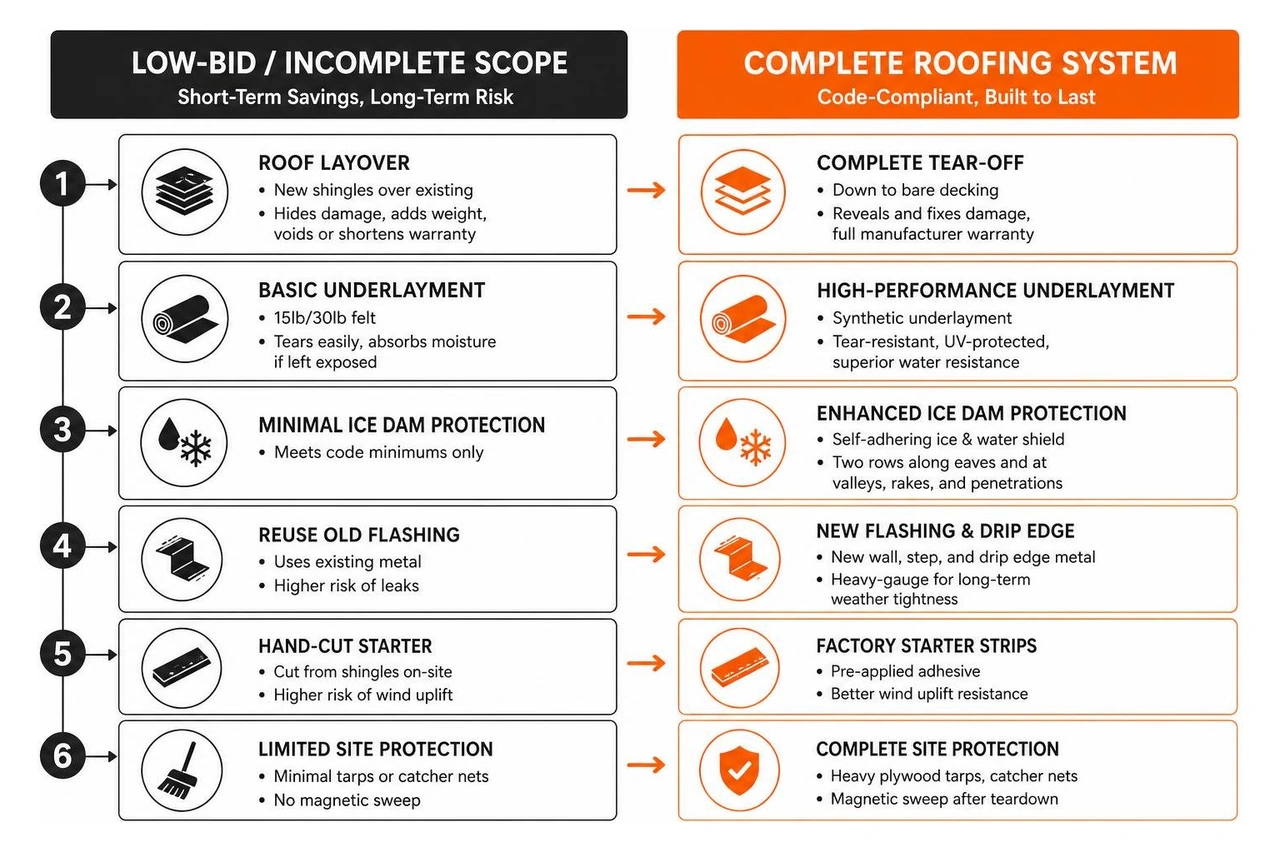
A main reason two estimates differ is that one includes a complete, code-compliant roofing system while the other quotes an incomplete scope. While residential roof replacements typically fall in a broad range from upper four figures to mid five figures, the final price depends heavily on roof size, pitch, existing layers, decking condition, selected materials, and required labor.
Complete Tear-Off vs. Roof Layovers
An overlay (installing new shingles directly over existing ones) costs less upfront because it eliminates tear-off labor and disposal fees. However, overlaying shingles carries severe long-term drawbacks:
- It hides underlying rot or water-damaged roof decking.
- It traps extra heat, which accelerates shingle degradation.
- It adds heavy weight to the house framing.
- Most shingle manufacturers shorten or void warranty coverage when installed over an old layer.
A complete tear-off down to the bare wooden deck is the standard for a durable, fully warrantied system.
Underlayment Quality
Underlayment acts as a secondary water barrier beneath shingles:
- Standard Asphalt Felt (15lb/30lb): Costs roughly $0.25 to $0.40 per square foot. It can tear easily during installation and absorb moisture if left exposed during weather delays.
- High-Performance Synthetic Underlayment: Costs around $0.40 to $0.75 per square foot. It offers tear resistance, UV protection, and superior water resistance across harsh seasonal shifts.
Severe Weather and Ice Dam Protection
In Central Wisconsin communities like Wausau, Minocqua, and Stevens Point, winter freeze-thaw cycles create severe ice dams. High-quality quotes include self-adhering peel-and-stick ice and water shield applied along eaves, valleys, rake edges, and around roof penetrations (like chimneys and skylights).
Installing two rows of ice and water shield along eaves, exceeding basic building code minimums, helps protect against water intrusion if ice dams occur, though it does not prevent ice dams by itself.
Flashing, Components, and Accessories
Reusing existing metal flashing is a common tactic to lower initial estimates, but aged wall flashing, step flashing, and drip edge are primary leak points. Replacing these critical accessories with new, heavy-gauge metal ensures long-term weather tightness.
Similarly, premium quotes specify factory-manufactured starter strips (which feature pre-applied adhesive to prevent wind uplift) rather than hand-cutting basic shingles on-site.
Ventilation Balancing
Improper attic ventilation causes heat and moisture buildup, leading to winter ice damming and summer shingle blistering. A thorough estimate incorporates calculated intake ventilation (at the soffits) paired with exhaust ventilation (such as continuous ridge vents) to maintain airflow and preserve warranty validity.
Decking Repairs
If tear-off reveals water-damaged plywood or rotted tongue-and-groove boards, those sections must be replaced before laying new underlayment. Reputable contractors clearly state per-sheet replacement pricing (typically $80 to $150 per plywood sheet) directly in the quote to eliminate pricing surprises mid-project.
| Scope Element | Low-Bid Incomplete Proposal | Comprehensive System Proposal |
|---|---|---|
| Removal | Single layer tear-off; leaves hidden layers | Complete tear-off down to bare wood decking |
| Underlayment | Basic 15lb asphalt felt paper | High-performance synthetic underlayment |
| Ice Protection | Code-minimum single row on eaves | Double-layer self-adhering ice/water shield |
| Flashings | Reuses old step & chimney flashing | Replaces all step, wall, and pipe flashing |
| Edge Protection | No drip edge or reused metal | New heavy-gauge aluminum drip edge |
| Ventilation | Keeps outdated or mis-matched vents | Calculated intake soffit & continuous ridge vents |
| Deck Allowance | Omitted; billed as expensive change order | Transparent per-sheet plywood replacement cost |
How Do Material Quality and Warranty Tiers Impact Your Final Estimate?
Material selection typically influences a roof's overall lifespan, storm resistance, and visual appeal, though actual lifespan varies by product, installation, ventilation, maintenance, and weather exposure. Understanding material differences helps explain cost variations between estimates.
Material Quality Tiers
- Standard 3-Tab Shingles: The lowest-cost option, featuring a flat appearance and basic weather resistance. Their lighter weight makes them more vulnerable to blow-offs during severe summer storms.
- Architectural/Laminated Shingles: Built with multiple layers of asphalt for a dimensional look. They offer higher durability, and some architectural shingles are rated up to 110 to 130 mph when installed as part of the required system.
- Premium Synthetic & Metal Roofing: Standing seam metal or stone-coated steel systems carry a significantly higher initial investment, but offer extended longevity and severe weather protection.
To quickly explore material tier costs for your property, you can generate an Instant Roof Quote or review our detailed Roofing Contractor Selection Guide.
Material Substitution Red Flags
Some quotes appear cheaper because a contractor lists a premium manufacturer name on the contract but intends to use off-brand or builder-grade accessory products (such as cut-up shingles for ridge caps or budget felt instead of system-matched underlayment). Using mismatched components can compromise system integrity and invalidate manufacturer warranties.
Understanding Manufacturer Warranties vs. Enhanced System Warranties
Standard manufacturer warranties (often advertised as 25- to 50-year or "lifetime" warranties) typically cover material manufacturing defects only. If a shingle fails due to a defect after 10 years, the manufacturer may supply replacement shingles, but the homeowner is responsible for paying tear-off, disposal, and labor costs.
By contrast, factory-enhanced system warranties offered through certified contractors (such as GAF Master Elite installers) cover:
- 100% of material defect costs for up to 50 years non-prorated.
- Full installation labor, tear-off, and disposal costs.
- Direct manufacturer backing even if the original installer leaves the business.
Contractor Workmanship Warranties
A company's workmanship warranty covers installation errors, such as improper fastening or improperly sealed flashings. Established contractors provide written workmanship warranties spanning 10 years or more, backed by dedicated service teams. Smaller operators may offer a 1-year verbal guarantee that offers little protection if leaks appear years later.
What Hidden Fees and Red Flags Should You Look for in a Low Roofing Estimate?
An unusually low estimate often leaves out critical items that reappear later as unexpected costs or hidden liabilities. Keep an eye out for these red flags:
Bids Unusually Below Competitor Averages
If three estimates come in around $16,000 to $18,000 and a fourth comes in at $10,500, exercise caution. A lower price may reflect differences in materials, scope, cleanup, warranty coverage, or installation details. In extreme cases, abnormally low bids stem from omitted workers' comp insurance, unpermitted work, or plans to issue substantial change orders after tear-off begins.
Demanding Large Upfront Deposits
According to data from the Better Business Bureau (BBB), roughly 20% of all roofing-related consumer complaints involve deposit theft or demands for excessive upfront payments.
A standard deposit typically ranges from 10% to 30% upon contract signing or when materials are delivered to your driveway. Be cautious of contractors demanding 50% or more upfront before any materials arrive on site.
Skipping Building Permits
Municipal building permits are required for roof replacements across Wisconsin communities. Pulling permits ensures a city or town building inspector reviews the roof to verify code compliance.
Some low-cost contractors exclude permit fees or ask homeowners to pull the permit as an "owner-builder." This practice transfers safety, liability, and code violation risks directly onto the homeowner. Always verify that the contract explicitly states the contractor will pull all required local permits in their business name.
Vague Scope Statements
Avoid proposals with vague line items such as "replace roof with 30-year shingles." A legitimate contract explicitly details:
- Manufacturer, product line, and precise color choice.
- Exact underlayment brand and ice shield square footage.
- Flashing materials, drip edge style, and ventilation plan.
- Site cleanup specifications, including magnetic sweeps and disposal fees.
Essential Questions to Ask Every Contractor Before Signing
- Are your installers full-time W-2 employees or seasonal subcontractors?
- Will you provide a Certificate of Insurance (COI) sent directly from your insurance provider listing my home address?
- Are all permit fees, dumpster fees, and property protection measures included in this price?
- What is the exact per-sheet replacement cost for damaged plywood decking?
- What written workmanship warranty do you offer, and is it backed by the manufacturer?
How Can You Compare Roofing Quotes Step-by-Step to Find the Best Value?
Comparing complex roofing proposals side-by-side requires a structured normalization process. Follow these steps to evaluate your options fairly:
Step 1: Create a Line-by-Line Comparison Matrix
Build a simple spreadsheet listing contractor names across the top and key project elements down the side:
- Tear-off and disposal inclusion
- Shingle manufacturer and product tier
- Underlayment type (felt vs. synthetic)
- Ice and water shield coverage area
- Drip edge, starter shingle, and ridge cap specs
- Flashing replacement details
- Ventilation calculations
- Decking replacement rate per sheet
- Permit fees and cleanup details
- Workmanship and manufacturer warranty terms
Step 2: Verify Materials and Scope Completeness
Confirm that each quote details matching material quality. If one contractor specified premium architectural shingles while another quoted entry-level shingles, ask the lower bidder to quote the higher-tier system so you can make an apples-to-apples comparison.
Step 3: Verify Licensing and Insurance Credentials
Never rely on verbal assurances. Verify contractor licensing through state resources like the Wisconsin Department of Safety and Professional Services (DSPS). Request that the contractor's insurance agent send an ACORD Certificate of Insurance directly to your email showing current General Liability and Workers' Compensation coverage.
Step 4: Evaluate Local Reputation and Stability
Review local history and customer feedback. Learn more about local quality standards by reviewing our guides on the Best Roofer in Wausau, WI and How Do I Choose a Roofing Contractor in Central Wisconsin. Choosing a contractor with established community roots ensures they will be around to honor their workmanship warranty.
Step 5: Explore Flexible Payment Options
If the highest-quality quote exceeds your initial cash budget, look into flexible financing plans rather than sacrificing material quality or system scope. Financing options are available for qualifying homeowners. Loan amounts up to $100,000 unsecured may be available, with final approval, rates, and terms based on lender review and credit qualification. Explore custom payment structures on our Financing page.
Step 6: Evaluate the Roof as Part of a Complete System
A durable home exterior works as an integrated weather protection system. When evaluating a roof replacement, consider how your Roofing system works alongside attic insulation to manage winter heat loss and prevent destructive ice dams.
Homeowners may qualify for Focus on Energy rebates. Focus on Energy rebates apply to qualifying insulation and air-sealing work (such as attic insulation, air sealing, wall insulation, foundation insulation, duct sealing, and qualifying DIY attic insulation and air sealing), rather than the roof replacement itself. Please note that A-RITE Exteriors specifically provides attic insulation services. Rebate amounts and eligibility rules change over time, so homeowners should always confirm current program rules before starting work.
Additionally, when evaluating energy-efficiency tax credits like Section 25C (Energy Efficient Home Improvement Credit), IRS guidance showed it was available through December 31, 2025; consult a tax professional to verify whether any current energy credits apply to your planned home improvements.
We also believe in supporting our local neighbors across Central Wisconsin. If you know a family facing hardship who needs a reliable roof, submit their story through our community-focused Free Roof Nomination program.
What Are the Most Common Questions About Roofing Quotes?
Why is one roofing quote thousands of dollars higher than another for the exact same home?
Price differences stem from material quality grades, crew structure (full-time W-2 employees vs. unvetted seasonal subcontractors), scope completeness (such as replacing flashings and adding ice shield vs. reusing old metal), warranty levels, and legitimate operational overhead (including full workers' compensation and general liability insurance).
What is a normal deposit for a roof replacement project in 2026?
A normal deposit ranges between 10% and 30% of the total contract price, paid upon signing or when materials arrive on site. Avoid contractors demanding 50% or more upfront before any work begins or materials are delivered.
Does a lower roofing quote mean I am getting a worse warranty?
A lower price may reflect differences in materials, scope, cleanup, warranty coverage, or installation details. Lower bids often include basic material-only manufacturer warranties that do not cover labor, tear-off, or disposal costs if shingles fail prematurely. Enhanced, non-prorated system warranties covering both materials and labor require certified contractors, which is reflected in overall project pricing.
How Should You Make Your Final Decision on a Roofing Estimate?

Choosing the right roofing proposal comes down to balancing upfront cost against long-term protection, durability, and peace of mind. While a low bid can appear attractive, omitting critical scope items, such as ventilation upgrades, complete tear-offs, or ice dam protection, can lead to severe damage over time. When water leaks or ice dams compromise your attic structure, repair can cost thousands of dollars, and severe cases can cost much more.
A transparent, line-by-line quote protects you from unexpected fees and ensures your home gets a complete roofing system built to withstand harsh Wisconsin weather.
Ready to compare your estimates with confidence? Contact our team today for an honest, transparent walkthrough of your roofing project. We will review your project requirements, explain every component, and provide a clear, line-by-line estimate tailored to your home.