What Are the Major Warning Signs That Siding Is Beyond Repair?
You should consider replacing your house siding instead of repairing it when damage is widespread across multiple walls or elevations, the underlying sheathing is soft or rotted, panels are brittle or warped in many areas, or repair estimates approach the cost of replacement. Minor cosmetic cracks, isolated loose trim, or localized panel damage on structurally sound sheathing can often be spot-repaired, but the right call depends on substrate condition, material matching, siding age, and repair economics.
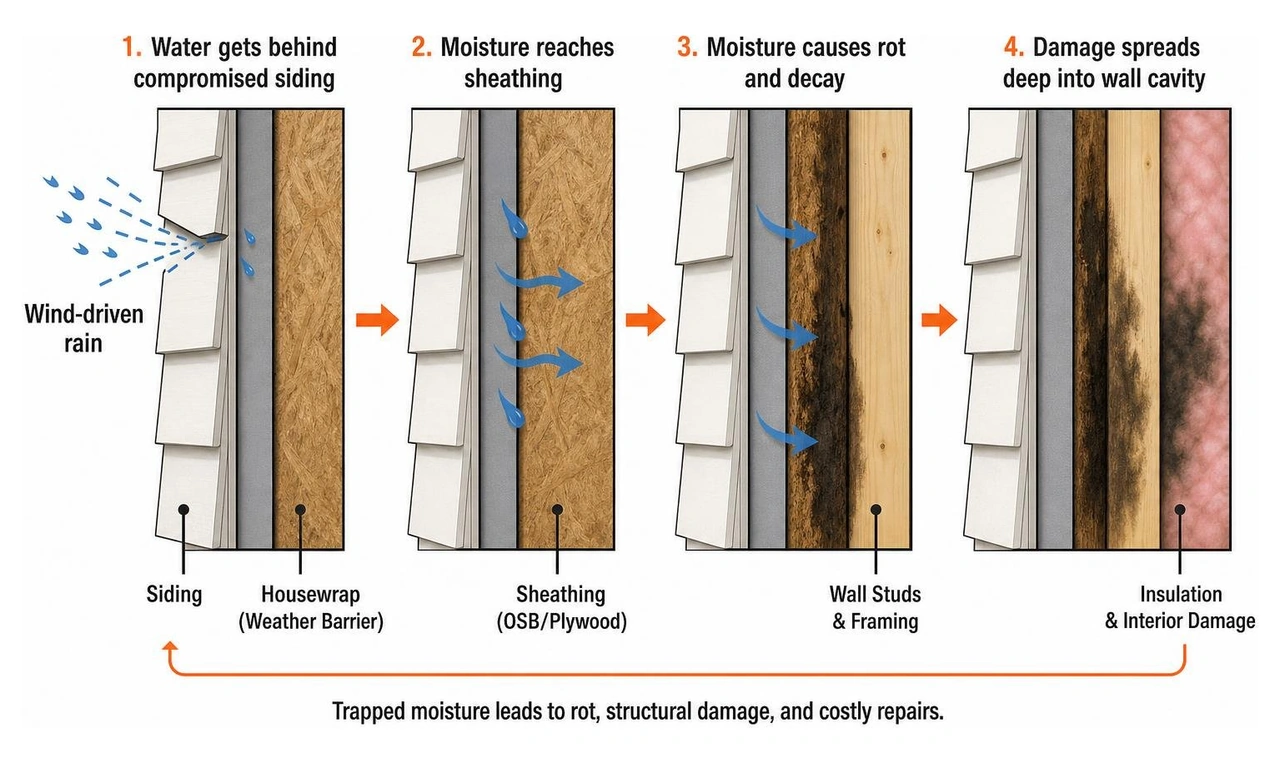
Siding is exterior cladding: it sheds most bulk water and protects the wall assembly from direct weather exposure. However, residential walls are designed with the expectation that some moisture can get behind the cladding. The weather-resistant barrier (WRB), housewrap, and flashing form the drainage plane that protects the wall cavity and directs incidental water back out. If you notice signs of moisture entering near eaves, windows, doors, or roof intersections, the issue may be tied to flashing, drainage, or hidden roofline moisture pathways; reviewing signs of hidden roof damage can help you identify whether your siding symptoms stem from roofline drainage failures or direct cladding breakdown.
Rot, Soft Spots, and Spongy Sheathing
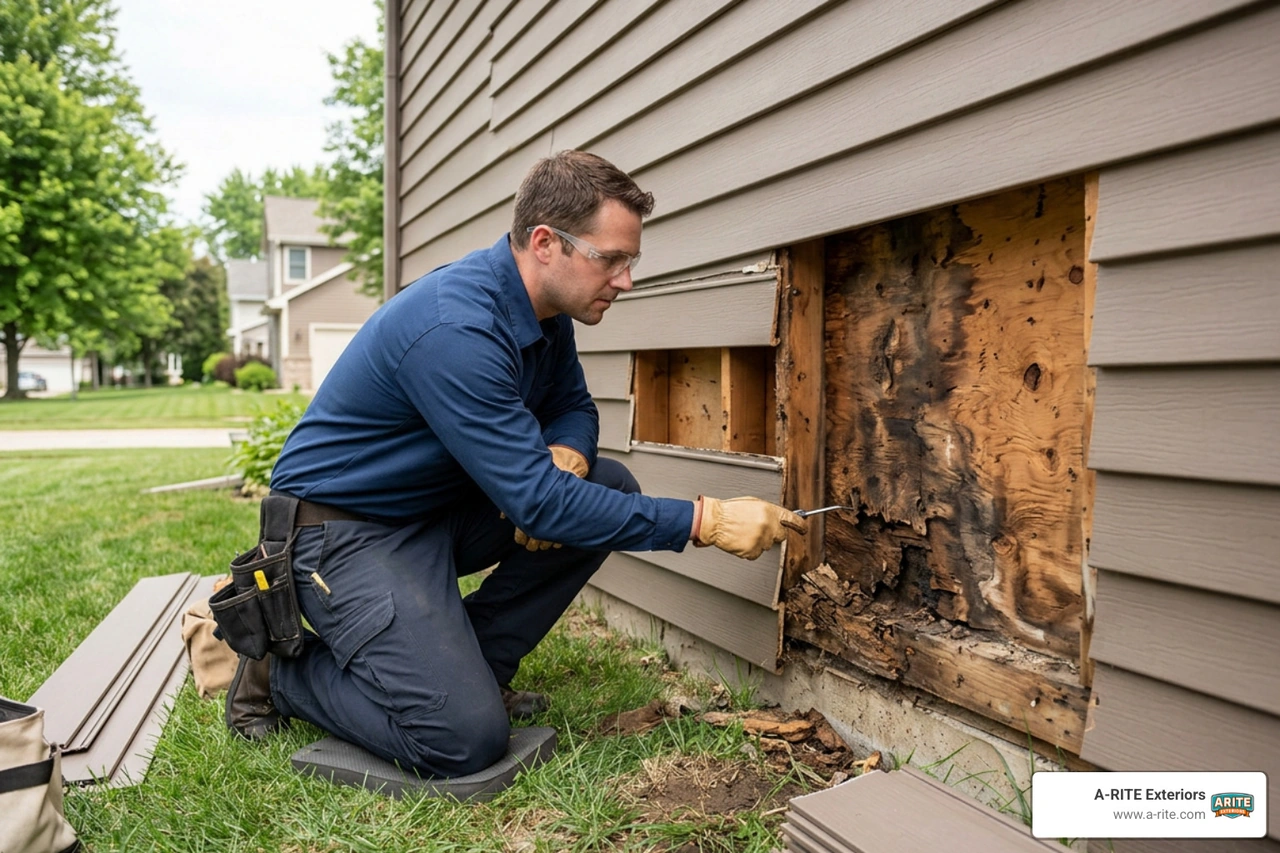
Wood and composite claddings are vulnerable to moisture absorption, and vinyl siding can sometimes conceal decay in the sheathing behind it. Look for visible distortion, staining, swelling, persistent damp areas, dark streaks, moldy odors, or siding sections that appear to be pulling away from the wall. If hidden rot is suspected, the most reliable next step is to have a qualified contractor remove a limited section of siding or trim so the sheathing, WRB, and flashing can be inspected directly.
Patching a cosmetic surface board over rotted sheathing creates a false sense of security. Trapped moisture can continue to degrade wall studs, decay structural framing, and ruin wall cavity insulation. When underlying sheathing shows widespread rot, complete removal of affected siding areas may be necessary to inspect, repair, and re-flash the substrate.
Widespread Warping, Buckling, and Brittle Panels
Central Wisconsin weather puts exterior materials through significant thermal cycling, often swinging from sub-zero winter freezes in Wausau and Minocqua to humid summer heat in Stevens Point. As siding expands and contracts, older, damaged, or improperly fastened materials can buckle and warp.
When panels warp, their interlocking seams may separate. This can create entry channels for wind-driven rain, melting snow, and ice dams. If warping or brittleness is confined to one small section, such as an area damaged by heat reflection from a neighbor's window or an accidental barbecue scorch, a spot repair may suffice. However, when panels across multiple elevations are wavy, brittle, cracked, or no longer locking together correctly, replacement may be more practical than repeated patchwork.
Interior Water Stains, Mold, and Peeling Paint
Exterior siding failures do not always remain isolated outdoors. Over time, persistent water intrusion can travel through sheathing, past vulnerable transitions, and into living spaces.
Common interior warning signs that deserve evaluation include:
- Peeling wallpaper or bubbling interior paint along exterior-facing walls.
- Unexplained dampness or dark water stains on drywall beneath window sills or near baseboards.
- Persistent mildew smells or visible mold spores blooming along exterior room corners.
Interior water damage can point to a compromised exterior wall assembly, but it can also come from window leaks, roof or gutter issues, plumbing, condensation, or flashing failures. Spot-caulking exterior seams may not address wet framing or saturated insulation inside the wall cavity, so visible indoor symptoms should be traced to the actual source before deciding between repair and replacement.
Pest Infiltration and Insect Damage
Degraded siding seams, soft wood corners, and warped trim boards can invite regional pests. Woodpeckers may drill into decaying cedar or composite siding searching for insect larvae, while carpenter ants, termites, mice, and bats can exploit tiny gaps along loose fascia and siding joints.
If you notice recurring insect activity or rodent entry points along exterior seams, the cladding may no longer be acting as an unbroken physical barrier. Addressing localized pest holes without correcting brittle, insect-damaged, or moisture-damaged materials can leave your wall assembly vulnerable to recurring infestations.
How Do Age and Material Determine Your Siding Lifespan?
Every siding material has an expected functional lifespan, though local climate conditions, product quality, installation standards, ventilation, maintenance, and weather exposure determine how gracefully it ages. Age should be used as context rather than as a strict repair-or-replace cutoff. A newer siding system with isolated damage may be repairable, while an older system with brittle panels, recurring leaks, or discontinued materials may be a better candidate for replacement.
| Siding Material | Common Planning Lifespan Context | Common Point of Failure | Repair vs. Replace Consideration |
|---|---|---|---|
| Vinyl Siding | Often planned around 20–40 years nationally; some products may last 50+ years, and A-RITE's Wisconsin guidance commonly frames vinyl around 30–40 years with longer life possible | Brittleness, fading, seam cracking, storm or impact damage | Repair isolated damage if matching panels are available and the wall behind them is sound; consider replacement when brittleness, fading, or damage is widespread |
| Fiber Cement | Commonly planned around several decades, varying by product, finish, installation, and maintenance | Joint caulking, paint finish wear, cracking, moisture exposure at cuts or edges | Repair or repaint localized issues when boards remain sound; consider replacement if delamination, moisture damage, or installation defects are widespread |
| Natural Wood | Often lasts decades with proper paint, stain, ventilation, and maintenance, but Wisconsin moisture and pests can shorten service life | Rot, insect boreholes, splitting, warping, finish failure | Spot-replace damaged boards where the surrounding material is sound; consider replacement if structural rot or recurring maintenance problems spread |
| Aluminum | Often lasts several decades, with appearance and finish condition usually driving decisions | Dents, oxidation, chalking finish, loose seams | Paint or repair minor dents if the system still sheds water properly; consider replacement if panels are heavily oxidized, loose, or difficult to match |
To understand how regional weather patterns affect these timelines, review our detailed guide on how long does vinyl siding last in Wisconsin. Harsh freeze-thaw cycles, heavy snow loads, and UV exposure commonly shorten realistic lifespans compared with ideal conditions.
Material Matching Challenges and UV Fading
A frequent hurdle in siding repair is product availability and aesthetic consistency. Over years of direct sunlight exposure, vinyl and aluminum siding oxidize and fade. Even if you track down the exact manufacturer and original color code, a brand-new factory panel may appear noticeably brighter and richer than the sun-bleached panels surrounding it.
Siding manufacturers may discontinue or reformulate colors, profiles, reveal widths, locking-lip designs, and product lines over time. Forcing a mismatched profile into an existing run can compromise the water channel and create an unsightly patchwork that detracts from your home’s curb appeal and market value.
Paint Degradation and Maintenance Frequency
Wood and older composite siding demand regular repainting and resealing. While repainting every 7 to 10 years is a common maintenance pattern, a sudden increase in maintenance frequency can signal a deeper problem. If fresh paint blisters, peels, or flakes unusually soon after application, possible causes include moisture, poor surface preparation, incompatible coatings, installation issues, flashing failures, or localized material damage. Continuing to pay for recurring scraping, priming, and painting on failing boards can become an expensive cycle compared with installing modern, low-maintenance cladding.
How Do Cost, the 50% Rule, and the Breakpoint Guide Your Choice?
Homeowners weighing repairs against a full exterior remodel often hit an economic "breakpoint": the threshold where patching old materials costs more over time than replacing the entire system.
Current HomeAdvisor planning data lists siding repair at an average of about $927, with a typical range of $367 to $1,523. Broader repair jobs can still fall outside that range depending on material, access, trim work, and whether hidden damage is discovered. HomeAdvisor also lists siding replacement at an average of about $11,590, with a typical national range of $5,561 to $17,724, while larger homes, premium materials, complex tear-offs, or sheathing repairs can cost more.
To make an objective financial decision, contractors and homeowners often rely on a common budgeting heuristic: if an itemized repair estimate reaches roughly 50% or more of the cost of full siding replacement, replacement may deliver better long-term value. Angi currently uses 50%+ of replacement cost as an indicator that replacement may be the better choice. This is not an industry requirement or universal rule, but it is a useful way to compare short-term patching against a longer-lasting exterior upgrade.
| Decision Metric | Siding Repair (Spot Fixes) | Full Siding Replacement |
|---|---|---|
| Typical Current Cost Context | Avg ~$927; typical range ~$367–$1,523, with wider repairs possible | Avg ~$11,590; typical national range ~$5,561–$17,724, with larger or more complex jobs costing more |
| Service-Life Impact | A proper isolated repair can last for the remaining service life of otherwise sound siding | New siding can reset the system's service life, depending on material, installation, maintenance, and weather exposure |
| Project Schedule | Often shorter, but varies by material, access, weather, and hidden damage | Usually longer and more involved; timing depends on home size, crew size, tear-off, sheathing repair, trim complexity, and weather |
| Resale ROI | Maintains condition and can prevent inspection concerns | 2025 Zonda national Cost vs. Value data reported 96.5% cost recouped for vinyl siding replacement and 113.7% for fiber-cement siding replacement; results vary by market and property |
| Best Scenario | Isolated impact or storm-panel damage on sound siding | Aging material, systemic rot, widespread damage, poor matching options, or high repair economics |
Widespread Damage Across Multiple Walls or Elevations
When damage spreads across multiple walls or elevations, labor costs and material-matching issues often shift the math toward replacement. Siding installation crews work most efficiently when stripping down full walls, installing continuous weather-resistant barriers where needed, and hanging consistent panel runs.
Piecing together scattered repairs across multiple walls requires careful demolition around aged, brittle materials, custom cutting, and individual seam blending. The labor overhead per square foot for complex sectional repairs can approach the cost of a complete teardown and re-side, without providing the same appearance, continuity, or warranty protection as a new installation.
Scope Breakdown: Repair vs. Full Replacement Estimates
When comparing contractor estimates, review what is included beneath the surface. When evaluating quotes, note that a lower price may reflect differences in materials, scope, cleanup, warranty coverage, or installation details.
A detailed proposal for premium siding replacement should clearly state whether the project includes:
- Complete removal and safe disposal of old siding panels and rotted trim.
- Inspection or repair of underlying plywood or OSB sheathing.
- Installation of a continuous, vapor-permeable weather-resistant barrier (WRB) integrated with flashing where appropriate.
- Applicable window and door flashing, kick-out flashings, and drip caps to help prevent water intrusion behind trim.
- Corner posts, trim details, soffit or fascia work if included in the contracted scope, and manufacturer-backed warranties.
Financing options are available for qualifying homeowners. Loan amounts up to $100,000 unsecured may be available, with final approval, rates, and terms based on lender review and credit qualification.
What Are the Hidden Risks of Delaying Siding Replacement?
Putting off necessary exterior replacement when siding has failed creates compounding structural risks. Siding is an important outer layer in the wall assembly, but the WRB, flashing, trim transitions, gutters, roof edges, and drainage details all work together to control water.
Without a reliable drainage plane and properly functioning exterior cladding, trapped rainwater and melting snow can rot structural wall studs, sill plates, and rim joists. Repairing rotted structural framing beneath compromised cladding can cost thousands of dollars, and severe cases can cost much more.
Beyond structural concerns, aging and drafty siding can compromise thermal performance. Warped or loose siding may allow cold wind and moisture to reach vulnerable parts of the exterior wall assembly, driving up heating bills during Wisconsin winters.
When planning comprehensive energy efficiency improvements, homeowners may qualify for Focus on Energy rebates. Focus on Energy rebates do not apply to siding replacement itself, but qualifying wall insulation and air-sealing work performed as part of an efficiency project may be eligible. Rebate amounts and eligibility rules change over time, and homeowners should confirm current program rules before starting work.
Regarding federal tax incentives, current IRS guidance says the federal Energy Efficient Home Improvement Credit is not available for property placed in service after December 31, 2025. Always consult a tax professional regarding tax credit availability and filing requirements.
If your exterior envelope needs attention across multiple fronts, including roofing, gutters, siding, windows, and attic insulation, it pays to understand who can help with roofing gutters siding windows and insulation near me to ensure your home is sealed properly from the roof deck down to the foundation.
What Are the Most Common Questions About Siding Repair vs. Replacement?
Can I repair isolated vinyl siding panels without replacing the whole wall?
Yes. If damage is limited to one or two panels, such as a puncture from a stray rock thrown by a lawnmower, an experienced installer or handy homeowner can unlock the damaged piece using a specialized vinyl siding zip tool. The technician unhooks the locking hem, pulls the nails from the nailing fin, slides the damaged panel out, and locks a replacement panel into place.
However, this repair is only viable if the underlying wall sheathing and housewrap are dry and structurally sound. If the existing siding has faded over years of UV exposure, the replacement panel will likely show a visible color variation. For A-RITE Exteriors, spot-repair examples are included here for homeowner education; the company’s strongest fit is evaluating larger siding replacement and full exterior-envelope needs across Central Wisconsin.
Does homeowners insurance cover siding replacement or only spot repairs?
Homeowners insurance typically covers siding damage caused by sudden, accidental perils, such as hail storms, windstorms, falling trees, or fire. Insurance policies generally exclude gradual wear and tear, age-related brittleness, rot, manufacturer defects, and pest infestations.
For Wisconsin homeowners, the Wisconsin Office of the Commissioner of Insurance explains that an insurer is generally required to pay for the damaged portion of aluminum or vinyl siding and is not obligated to make replacement siding match the undamaged siding. Additional policy language or endorsements may provide greater coverage, so review your policy and ask your agent or adjuster how matching, discontinued materials, and undamaged elevations are handled.
Should I replace my siding before selling my home even if damage seems minor?
If your siding shows noticeable rot, heavy warping, or obvious patching, replacing it before listing can protect your sale price. According to the 2025 Zonda national Cost vs. Value report, vinyl siding replacement recouped 96.5% of project cost and fiber-cement siding replacement recouped 113.7%. Results vary significantly by market, property, material, and buyer expectations, so these figures should be treated as national benchmarks rather than guaranteed resale gains.
Prospective homebuyers and professional home inspectors scrutinize building exteriors. Damaged siding raises red flags about hidden moisture damage and neglected maintenance, which often results in lower offers, repair escrows, or buyers walking away during the inspection contingency period.
How Can You Make the Right Decision for Your Home's Exterior?
Deciding whether to repair or replace your siding comes down to evaluating four primary metrics:
- Damage Pattern: Is the damage isolated to one small area, or does it appear across multiple walls or elevations?
- Structural Substrate: Is the wood sheathing beneath your siding firm and dry, or is there evidence of staining, swelling, soft areas, or rot that needs direct inspection?
- Cost Ratio: Does your itemized repair quote approach 50% or more of the cost of a full replacement, a common budgeting heuristic rather than a hard industry requirement?
- Age and Availability: Is your siding older, brittle, heavily faded, or difficult to match because colors, profiles, or product lines have changed?
If your siding is structurally sound and only dealing with minor, localized impact damage, a spot repair may be a practical, cost-effective solution. But if you are facing widespread warping, recurring paint failure, hidden moisture concerns, poor material matching, or repeated patch jobs, full replacement may provide better long-term peace of mind and protection.
At A-RITE Exteriors, we bring a roof-first, weather-resistant perspective to every home exterior we evaluate across Wausau, Stevens Point, Minocqua, Weston, Mosinee, and throughout Central Wisconsin. We thoroughly inspect your wall assemblies, flashing details, and building envelope to ensure your home is ready to handle harsh winters and summer storms. Contact our team today to schedule an exterior inspection and find the right solution for your home.